
The global cryptocurrency market is navigating a critical juncture in November 2025, balancing post-halving cycle expectations against a shifting macroeconomic landscape. Following a period of consolidation, traders and analysts are scrutinizing key technical levels and on-chain metrics to gauge the next directional move. This comprehensive credible crypto analysis examines the current market structure for major digital assets, including Bitcoin and Ethereum, incorporating Elliott Wave count projections, liquidity data, and the ongoing influence of institutional capital flows via spot ETFs. The primary question facing investors is whether current price action represents a healthy pullback within a broader bull market or the precursor to a deeper correction, a query this report addresses through a neutral, data-driven lens.
Current Market Overview and Bitcoin Outlook
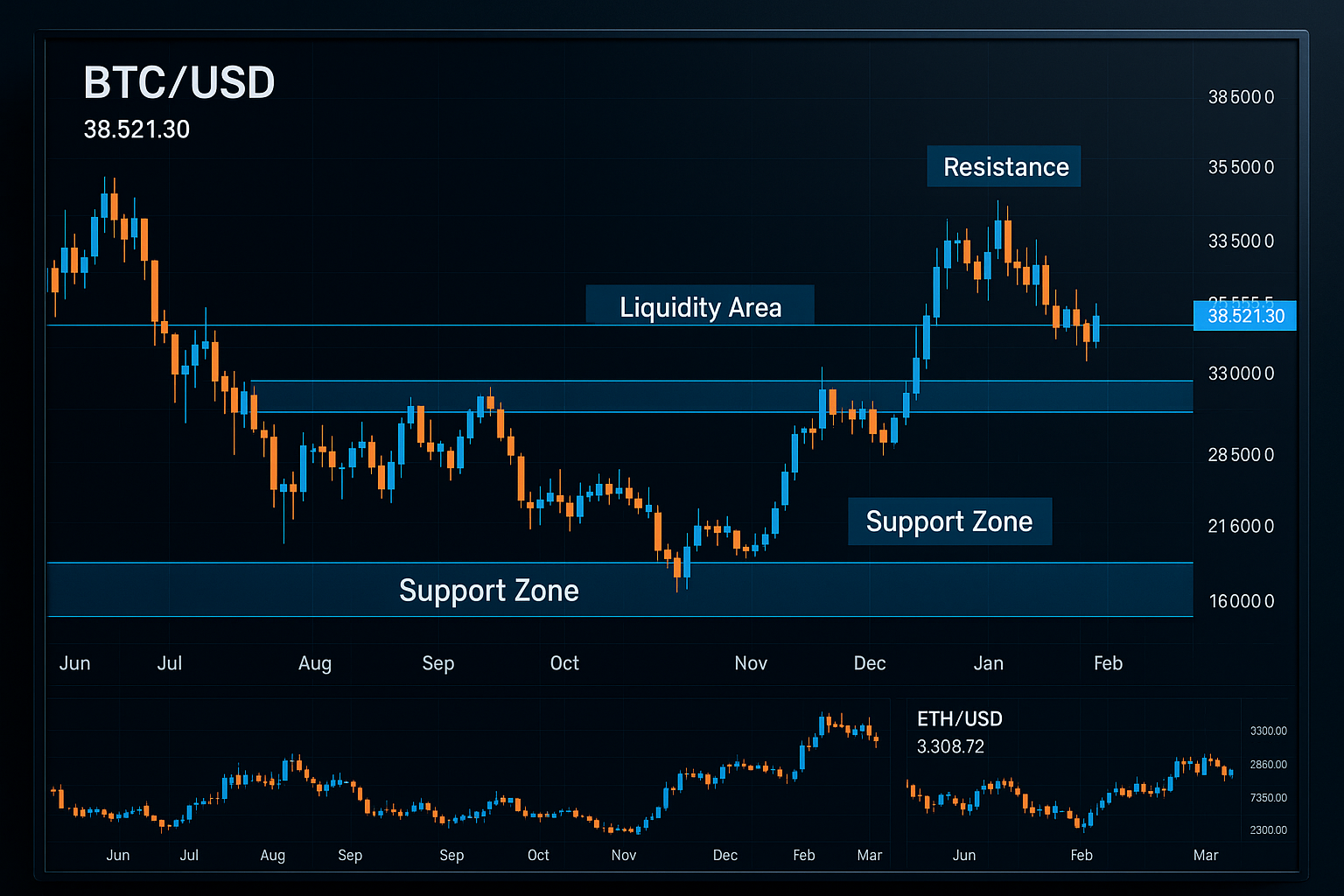
As of early November 2025, the cryptocurrency market capitalization hovers around $2.5 trillion, reflecting a 15% retracement from its Q3 2025 highs. Bitcoin (BTC), the market bellwether, has been trading between $55,000 and $65,000, a zone that has acted as both support and resistance throughout the year. The current credible crypto bitcoin outlook suggests that Bitcoin’s performance is largely dictating the sentiment for the entire digital asset space. Its dominance rate (BTCD) sits at approximately 52%, having slightly declined from recent peaks, indicating a tentative capital rotation into alternative assets.
The prevailing market structure on higher timeframes remains a topic of intense debate among analysts. While the long-term trend, defined by a sequence of Higher Highs (HH) and Higher Lows (HL) initiated in late 2022, is technically still intact, the intermediate trend has been damaged. The recent breakdown below the $60,000 psychological level has shifted the short-term bias to neutral-to-bearish. According to data from TradingView and CoinMarketCap, trading volumes have spiked during sell-offs, suggesting distribution, while buying volume on upswings has been comparatively anemic. This volume profile often indicates a lack of strong conviction among bulls at current levels.
From a fundamental perspective, Bitcoin’s network health presents a mixed picture. While price has corrected, the underlying network continues to demonstrate resilience. Hash rate remains near all-time highs, signaling robust security and miner commitment despite the post-Bitcoin halving cycle pressure on revenues. However, on-chain data from Glassnode indicates that the Short-Term Holder (STH) realized price—often a key support level in bull markets—has been tested and temporarily lost. This development warrants caution, as a prolonged period below this level has historically preceded deeper corrections. The current credible crypto analysis must therefore weigh strong long-term fundamentals against concerning short-term technical and on-chain signals.
Ethereum and Altcoin Season Signals
Ethereum (ETH), the leading smart contract platform, has mirrored Bitcoin’s corrective phase but with notable nuances. Its price action against Bitcoin, captured in the ETH/BTC pair, is a critical gauge for altcoin season potential. After a prolonged downtrend, the ETH/BTC ratio has shown signs of basing around the 0.055 level. A decisive breakout above 0.06 would be a strong technical signal that capital is rotating from Bitcoin into Ethereum, which historically acts as a precursor to broader altcoin strength. The credible crypto ethereum forecast is cautiously optimistic for a relative outperformance, contingent on a stabilization in the broader market.
The altcoin market capitalization ex-BTC and ETH has experienced significant volatility. So-called “blue-chip” altcoins like Solana (SOL), Avalanche (AVAX), and Chainlink (LINK) have seen drawdowns of 25-40% from their yearly highs. This has led to discussions among analysts about whether this is a healthy cleansing of leverage or the beginning of a more sustained bearish trend for the sector. The credible crypto altcoin season thesis hinges on several factors: a stabilizing Bitcoin, improving ETH/BTC ratio, and a resurgence in decentralized application (dApp) activity and Total Value Locked (TVL) across various Layer 1 and Layer 2 ecosystems.
Specific analysis, such as the credible crypto xrp analysis, highlights the idiosyncratic nature of certain assets. XRP’s price action continues to be heavily influenced by regulatory developments and legal proceedings between Ripple and the U.S. Securities and Exchange Commission (SEC), often decoupling it from broader market trends. This underscores a critical point in any credible crypto assessment: while macro and Bitcoin sentiment provide the tide that lifts or lowers all boats, individual project fundamentals, regulatory clarity, and liquidity profiles create significant dispersion in performance. Current data from IntoTheBlock shows that the overall altcoin market’s Net Unrealized Profit/Loss (NUPL) has reset to neutral levels, a condition from which sustainable rallies have often begun, provided Bitcoin finds a stable footing.
Elliott Wave and Technical Structure Breakdown
Technical analysts often employ the Elliott Wave theory to identify recurring long-term price patterns and investor psychology. A prominent crypto analyst known as “Credible Crypto” has garnered attention for their detailed wave counts. Applying this framework to the current market, the primary interpretation for Bitcoin’s trajectory from its 2022 low is that it completed a five-wave impulse pattern into the 2024 all-time high. The subsequent price action is now being interpreted as a large-scale corrective pattern, likely a complex A-B-C structure.
Within this Elliott Wave count, the rally from the Q3 2025 low to the September high is labeled as a Wave B bounce. The current sell-off is thus potentially Wave C down, which, if valid, could see prices test deeper support levels, potentially towards the $48,000 – $52,000 zone, which coincides with the 0.618 Fibonacci retracement of the entire bull market run and a key on-chain support band. It is crucial to note that Elliott Wave interpretation is probabilistic, not deterministic, and alternative counts exist. Some analysts argue that the entire move from the 2022 low is a larger Wave 1, and we are now in a prolonged Wave 2 correction, which would still allow for new highs later in the cycle but would involve more consolidation or downside in the immediate term.
This technical analysis crypto approach provides a framework for establishing clear credible crypto invalidation level points. For the bearish Wave C count to be invalidated, Bitcoin would need to reclaim and sustain above the September high, effectively breaking the series of Lower Highs (LH). Such a move would force a re-evaluation of the wave count and would likely open the path for a resumption of the primary bull trend. This objective method of defining invalidation levels is a cornerstone of a disciplined, credible crypto trading strategy, as it removes emotional decision-making and replaces it with a rules-based approach to market navigation.
Key Support Resistance and Invalidation Levels
For traders and long-term investors alike, identifying precise support and resistance levels is paramount for credible crypto risk management. For Bitcoin, the immediate resistance zone is firmly established between $62,000 and $65,000. This area was previously a strong support floor and has now flipped into resistance—a classic example of an S/R flip. A decisive daily close above $65,000 would be the first technical signal that bullish momentum is returning.
On the support side, several key tiers are in focus. The first significant support sits near $55,000, which held strong in early October. A breach of this level with conviction would likely trigger a wave of liquidations, pushing Bitcoin towards the next major demand zone between $48,000 and $52,000. This lower band represents a confluence of technical factors: the 200-day moving average, the 0.618 Fibonacci retracement, and a significant on-chain volume node where a large number of addresses acquired their coins. For Ethereum, the analogous support and resistance levels are $3,200 (resistance), $2,800 (initial support), and a more critical support band between $2,200 and $2,400.
Establishing clear credible crypto invalidation level points is what separates speculative gambling from analytical trading. For a bullish bias to be maintained, the aforementioned deep support zones must hold. A weekly close below $48,000 for Bitcoin, for instance, would invalidate most near-term bullish credible crypto predictions and suggest a more profound bear market is underway. Conversely, for those with a bearish short-term outlook, a reclaim of $68,000 would serve as their invalidation. Defining these parameters before entering any position allows for precise position sizing and calculated risk-taking, ensuring that no single trade can cause catastrophic portfolio damage.
On-Chain Data and Liquidity Heatmaps
Beyond pure price action, on-chain metrics provide a deep, data-driven view into network activity and investor behavior. Key indicators are currently painting a nuanced picture. The MVRV (Market Value to Realized Value) Z-Score, which measures whether an asset is over or undervalued relative to its historical norm, has cooled from overbought territory and is now approaching a neutral state. This suggests that the extreme overvaluation seen at the peak has been largely corrected.
Funding rates in the perpetual futures market, which had been persistently positive (indicating traders were paying a premium to be long), have normalized and even turned slightly negative at times during the sell-off. This flushing out of excessive leverage is a healthy development for the market’s foundation, reducing the risk of a cascading long liquidation event. Similarly, aggregate open interest has declined from its highs, indicating that speculative froth has been reduced. However, analysts monitor this closely, as a sharp rebound in price coupled with rising open interest can signal the start of a new trending move.
Liquidation heatmaps, available from data providers like Hyblock, are essential tools for anticipating short-term price volatility. These heatmaps visualize the concentration of potential long and short liquidations. Currently, clusters of leveraged long positions are visible above the market price, around the $64,000 and $68,000 levels for Bitcoin. This creates a “liquidity grab” incentive for the market to move higher to trigger these liquidations, which can fuel a short squeeze. Below the market, a dense cluster of stop-losses and short liquidations sits near $53,000 and, more significantly, around $48,500. A move down to sweep these liquidity pools—a liquidity sweep—before reversing is a common market behavior that technical traders watch for.
Macro Factors CPI FOMC And ETF Influence
The cryptocurrency market no longer operates in a vacuum; it is increasingly correlated with traditional macro assets, particularly in a high-interest-rate environment. The decisions of the U.S. Federal Reserve, communicated through FOMC statements and meeting minutes, are a primary driver of global liquidity conditions. The market’s focus remains squarely on the trajectory of interest rates and the Fed’s balance sheet. Recent CPI (Consumer Price Index) reports have shown a stubborn but gradual decline in inflation, leading the market to price in a potential rate cuts cycle beginning in late 2025 or early 2026.
The narrative of “higher for longer” interest rates has been a headwind for risk assets, including crypto. High yields on Treasury bonds provide a compelling, low-risk alternative to volatile digital assets, drawing capital away from the sector. Therefore, any dovish pivot from the Fed, or even signals that the tightening cycle is definitively over, would be interpreted as a strong positive catalyst. Traders closely watch the U.S. Dollar Index (DXY) and bond yields, as a weakening dollar often provides a tailwind for Bitcoin.
Perhaps the most significant structural shift for the crypto market in 2024 was the approval of spot Bitcoin Exchange-Traded Funds (ETFs) in the United States. The SEC ETF news was a watershed moment, legitimizing the asset class for a vast pool of institutional and retail capital. The credible crypto spot etf impact analysis reveals a substantial and sustained net inflow of capital into these products, creating a new, powerful source of buy-side pressure. However, these flows are not one-directional; days of net outflows have also been recorded during periods of bearish sentiment, demonstrating that the ETF channel is a two-way street. The continued flow data from these ETFs, available from sources like Bloomberg, is now a critical fundamental dataset for any credible crypto macro analysis.
Risk Management and Trading Strategy Insights
In a market known for its high volatility, a robust framework for credible crypto risk management is the most critical component of long-term survival and success. The core of this framework is position sizing. A common strategy among professional traders is to risk no more than 1-2% of their total portfolio capital on any single trade. This ensures that a string of losses does not critically impair the portfolio, allowing the trader to remain in the game.
The risk-reward ratio (RR) is another fundamental concept. Before entering a trade, identifying a clear profit-taking target and a stop-loss level allows for the calculation of the RR. For instance, a trade that risks $1,000 to make a potential $3,000 has a 1:3 RR ratio. A credible crypto trading strategy typically seeks setups with a favorable RR, acknowledging that not all trades will be winners, but that winners can outweigh losers over time. This is often combined with technical analysis to identify high-probability supply and demand zones for entry and exit.
Furthermore, the use of leverage in perpetual futures contracts is a double-edged sword that amplifies both gains and losses. While it can be tempting, excessive leverage is the primary cause of rapid liquidations, especially during volatile liquidity sweep events. A credible crypto approach strongly cautions against high leverage, especially in uncertain market conditions. For long-term investors, a DCA strategy (Dollar-Cost Averaging)—investing a fixed amount at regular intervals regardless of price—has proven to be an effective method for navigating volatility and avoiding the pitfalls of emotional market timing
Volatility, Position Sizing, and Market Psychology
The crypto market’s inherent volatility index, often measured by instruments like the BVIV (Bitcoin Volatility Index), is a key input for strategy. Periods of low volatility often precede explosive price moves, while high volatility can indicate trend climaxes or panic selling. Currently, volatility has compressed from its 2024 highs but remains elevated compared to traditional asset classes. This environment demands larger price buffers when setting stop-losses and profit targets to avoid being “whipped” out of positions by normal market noise.
As previously mentioned, position sizing must be dynamically adjusted based on the perceived volatility and the clarity of the market structure. In a clear, trending market, position sizes can be increased modestly. In a choppy, range-bound, or highly uncertain environment like the present, reducing position size is a prudent form of risk management. This practice directly ties into market psychology—the discipline to trade smaller when confidence in a directional bet is low.
Market psychology itself is a powerful driver. Greed and fear are quantified by indices like the Crypto Fear & Greed Index, which has recently moved from “Greed” to “Fear” territory. This shift in sentiment can be a contrarian indicator. Extreme fear can signal a potential buying opportunity, as weak hands are shaken out, while extreme greed can signal a market top. A credible crypto perspective understands that the market is a mechanism for transferring wealth from the impatient to the patient. Maintaining emotional discipline, sticking to a pre-defined strategy, and avoiding FOMO (Fear Of Missing Out) and FUD (Fear, Uncertainty, and Doubt) are the intangible skills that separate successful participants from the crowd.
Expert Opinions and Credible Crypto Analyst Commentary

To build a holistic view, it is essential to consider a diversity of expert opinions. The credible crypto newsletter and credible crypto youtube channel ecosystem provides a range of analyses. For instance, analysts at firms like Glassnode have pointed to the drawdown in the Delta Price metric, which suggests the market is approaching a zone where long-term investors have historically found value. They emphasize that while short-term pain is possible, the long-term holder cohort continues to accumulate, indicating strong conviction.
Meanwhile, commentary from institutions referenced by Bloomberg Crypto often focuses on the macro picture. Analysts from traditional finance firms highlight the correlation between crypto and tech stocks (NASDAQ) and stress the importance of the upcoming FOMC guidance. Their credible crypto predictions are often more conservative, framed within the context of a multi-asset portfolio and the search for non-correlated returns.
The individual analyst known as Credible Crypto, through their credible crypto x posts and video content, has maintained a specific technical focus. Their primary thesis, as of this writing, leans towards one more significant down-move to complete a larger corrective pattern (Wave C) before the resumption of the bull market. They consistently pair this outlook with clear credible crypto invalidation levels, demonstrating a disciplined approach. It is worth noting that no single analyst or source holds a monopoly on truth. A robust credible crypto portfolio insights strategy involves synthesizing views from multiple credible crypto analyst sources, cross-referencing them with on-chain and technical data, and aligning them with one’s own investment horizon and risk tolerance.
Summary and Forward Outlook
The cryptocurrency market in November 2025 is characterized by technical uncertainty within a still-intact long-term bullish trend. Bitcoin is testing crucial support levels, with its price action being heavily influenced by traditional macroeconomic factors like Fed policy and the flows of spot Bitcoin ETFs. The credible crypto bitcoin outlook is cautiously optimistic for a year-end rally, but contingent on holding key support zones and a improvement in macro liquidity conditions.
The credible crypto ethereum forecast and the potential for an altcoin season are closely tied to Bitcoin’s stability. A strengthening ETH/BTC ratio is the first signal to watch for a broader rotation into riskier digital assets. Technically, the application of Elliott Wave theory suggests the market may be in the final stages of a complex correction, though this count requires price confirmation. The principles of credible crypto risk management—careful position sizing, defined risk-reward ratio (RR), and a wary approach to leverage—are paramount in the current environment.
Closing Section
In summary, the path forward for digital assets is at an inflection point. The convergence of technical analysis, on-chain metrics, and macro-economic drivers creates a complex but analyzable picture. The coming weeks will be critical in determining whether the market is building a foundation for the next leg up in the ongoing bull run or if it is entering a more protracted bear market rally. Market participants are advised to monitor key technical levels, particularly the support and resistance bands for Bitcoin and Ethereum, alongside high-impact macroeconomic events such as CPI releases and FOMC meetings. The flow data from U.S. spot Bitcoin ETFs will also remain a critical real-time gauge of institutional sentiment. A disciplined, data-informed, and patient approach, as championed by credible crypto analysis, is the most reliable strategy for navigating the inherent volatility and uncertainty of the cryptocurrency markets.
Disclaimer: This article is for informational and educational purposes only and should not be construed as financial advice or a recommendation to buy, sell, or hold any digital asset. The cryptocurrency market is highly volatile, and readers should conduct their own research and consult with a qualified financial advisor before making any investment decisions.