
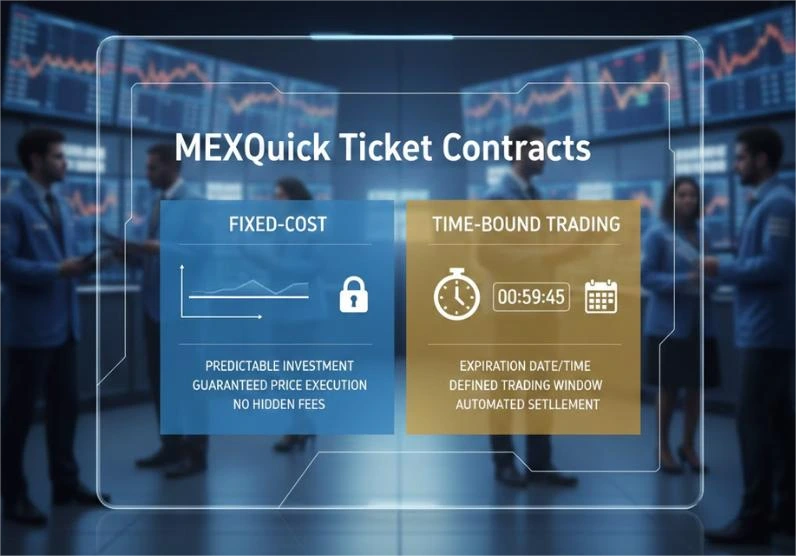
The world of cryptocurrency trading is characterized by a constant evolution of products and strategies. While traditional leveraged derivatives like futures and options have become mainstream, their complexity and inherent risks—particularly around margin, liquidation, and open-ended exposure—can present significant barriers to confident participation.
In response to this landscape, innovative contract models are emerging, designed not merely as variations of existing instruments but as distinct structural approaches. This article examines one such model: Ticket Trading on the MEXQuick. This article serves as a detailed educational guide to this core offering. Our purpose is to explain what Ticket Contracts are, how they function, and where they fit within the platform’s ecosystem. We will clearly outline the product’s logic, including its fixed-cost entry, time-bound lifecycle, and dynamic exposure mechanism, and provide a transparent overview of its operational structure and inherent risks.
What Is Ticket Trading?
At its conceptual core, ticket trading represents a shift from managing a continuously active, leveraged position to participating in a defined, time-bound market event with pre-known parameters. Conceptually, ticket trading is about time-bounded participation.
The term “ticket” is analogous to possessing a credential for a specific journey with a fixed departure, a known maximum cost, and a predetermined arrival time. You are not piloting the vehicle in open skies with constant fuel adjustments; instead, you are a participant on a scheduled flight where the exposure to the journey’s outcome is contained within the ticket’s validity period.
Ticket Trading on MEXQuick operationalizes this concept through its native Ticket Contract. It is crucial to understand from the outset that a Ticket Contract is not a futures contract, an options contract, or a binary option. It does not employ a margin account with tiered maintenance requirements, it has no liquidation engine that forcibly closes positions, and its payoff structure is distinct. It is a proprietary financial construct developed by MEXQuick with its own set of rules and behaviors.
The fundamental divergence from traditional leveraged trading lies in the simplification of the risk framework. In a standard futures trade, a trader must actively manage collateral (margin), which changes in value with the position and market moves, and faces the ever-present risk of a liquidation event if the market moves against them beyond a certain point.
Ticket Trading, by design, seeks to abstract this complexity. A user acquires a Ticket Contract at a fixed entry cost. This cost is the maximum possible loss. There is no additional margin to post, and no liquidation mechanism exists. The contract then runs its predefined course, with the user’s potential outcome dynamically tied to the underlying asset’s price movement within that specific time window. The goal of this model is structural clarity: before entry, the participant knows the exact maximum loss, the exact duration of exposure, and the mechanics of settlement.
Understanding the Ticket Contract Model
To grasp Ticket Trading, one must move beyond interface features and understand the underlying contract logic. The model is built on three interdependent pillars: a pre-defined maximum cost with defined risk, a strictly time-bound lifecycle, and a dynamic exposure mechanism. Together, these pillars create a self-contained trading unit with predictable boundaries.
Fixed Entry Cost and Defined Risk
This is the foundational principle of the Ticket Contract and the primary source of its structural difference.
Entry Price as Maximum Loss: When a user purchases a Ticket Contract, they pay a single, fixed price. This amount is the total capital committed to that contract. Crucially, this cost represents the absolute maximum financial loss the user can incur from that specific contract. There is no scenario where the user will be asked to inject more capital into that position or will lose more than that initial outlay.
No Margin Calls: The concept of “margin” as used in futures or margin spot trading is absent. Since the maximum loss is capped at the entry cost, there is no mechanism for a margin call—a demand for additional funds to maintain the position. The risk parameter is static and known at inception.
No Liquidation Mechanics: Liquidation is a process where an exchange’s system automatically closes a leveraged position when its losses approach the total collateral value. Ticket Contracts have no such mechanism. The position cannot be forcibly closed by the platform before the contract’s natural expiration. It will run for its entire predefined duration, settling based on the final conditions at expiry.
This design transforms risk from a dynamic, management-intensive variable into a fixed, known constant.
Time-Bound Contract Lifecycle
A Ticket Contract is not an open-ended position that a user holds indefinitely. It is a financial instrument with a built-in shelf life.
Predefined Time Cycles: Each Ticket Contract is created with a specific duration. This could be minutes, hours, or another set period, depending on the contract specification. This duration is immutable once the contract is purchased.
Automatic Settlement: Upon reaching the end of its lifecycle, the contract settles automatically. The settlement process determines the final outcome (profit or loss) based on the price of the underlying asset at expiry relative to the contract’s entry conditions. The user does not need to manually close the position.
Why this time structure matters becomes clearer when compared to open-ended contracts. The time dimension is not incidental; it is a core structural parameter. It defines the window of market exposure. This contrasts with perpetual futures, which have no expiry and can be held for years, requiring continuous funding fee payments and risk management. The fixed duration of a Ticket Contract creates a discrete, analyzable market event, focusing the participant’s analysis on price behavior within a specific temporal frame.
Dynamic Exposure Mechanism
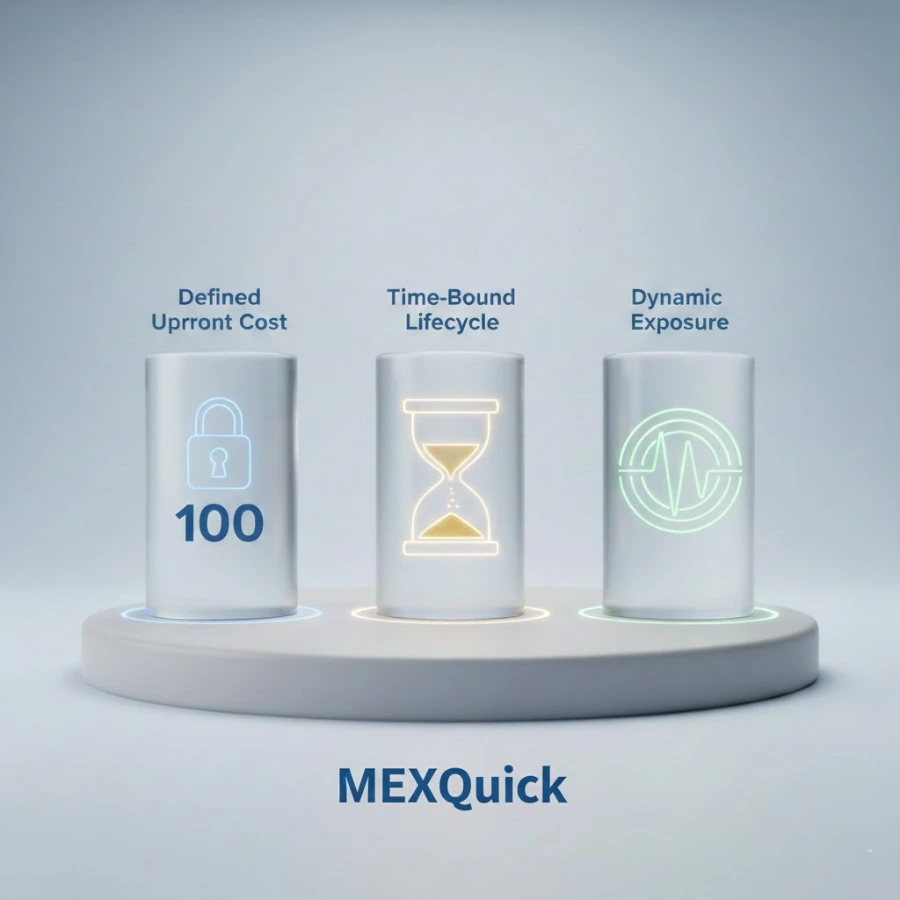
This is the most technically nuanced pillar of the model. While the risk (maximum loss) is fixed, the contract’s exposure to the market—its effective sensitivity to price moves—is not static.
How exposure evolves
A Ticket Contract’s potential payout does not have a linear, one-to-one relationship with price movement from the moment of entry. Instead, the contract’s value is designed to respond more sensitively to price movements as time passes and the contract approaches its expiration. Conceptually, the further into the contract’s lifecycle, the greater the impact of a given price move on the contract’s settlement value.
Why this is not static leverage
It is vital to avoid conflating this with traditional leverage. In a 100x leveraged futures position, the exposure is effectively magnified by a constant factor of ten from the outset. The dynamic exposure in a Ticket Contract is a function of the product’s proprietary pricing model and time decay structure. It is not a simple multiplier on the user’s capital. The exposure grows organically within the contract’s lifecycle, bounded by the fixed maximum loss.
How to think about it conceptually
Imagine a thermometer designed to measure a temperature change over a set 10-minute period. In the first minute, its reading might change slowly. In the final minute, the same temperature shift might cause a much more rapid movement on the gauge. The thermometer’s sensitivity to change increased over time, even though the instrument itself had fixed physical limits. The Ticket Contract’s exposure operates on a similar conceptual principle within its financial limits.
In synthesis, a Ticket Contract is a short-cycle, time-bound trading contract with a structured entry fee, no margin requirements, and no liquidation mechanism, where market exposure evolves dynamically within a predefined contract lifecycle. This definition encapsulates the three pillars into a single, coherent model.
Why Ticket Trading Was Designed
Understanding the rationale behind a financial product’s design is key to evaluating its place in the market. Ticket Trading was not created in a vacuum; it was developed as a structural response to observable complexities and frictions within existing leveraged trading paradigms. The design objectives are rooted in simplification and risk parameterization, not in the elimination of risk.
The design objectives are rooted in:
Complexity of Margin Systems: Traditional margin trading involves understanding initial margin, maintenance margin, margin ratios, and equity calculations. For many participants, this administrative overhead distracts from core market analysis. Ticket Trading abstracts this away by replacing a dynamic collateral system with a single, fixed-cost entry.
Liquidation Risk as a Dominant Stressor: The threat of liquidation—a sudden, automatic loss of one’s entire position—is a significant psychological and financial burden in leveraged trading. It can lead to risk-averse behavior even in sound strategies and can result in total loss of collateral from short-term volatility. By designing a contract with no liquidation mechanism and a fixed maximum loss, Ticket Trading seeks to remove this specific, acute risk vector. The user may lose their entire entry cost, but it will be a known outcome at expiry, not a surprise event mid-trade.
Psychological Pressure of Open-Ended Leverage: Managing an open-ended, leveraged position requires constant vigilance. Market moves can happen at any hour, requiring stops, hedges, or adjustments. The time-bound nature of a Ticket Contract confines the participation to a specific window, allowing for a more defined analytical focus and potentially reducing the stress of indefinite, 24/7 position management.
It is critical to state that Ticket Trading is a structural simplification, not risk elimination. The risks are merely transformed and re-parameterized. Market risk remains paramount if the market moves against the user’s expectation during the contract’s lifecycle, they will incur a loss, up to the fixed maximum. The product design addresses specific mechanical and psychological complexities of traditional leverage but does not alter the fundamental uncertainty of future price movements.
Pricing Mechanism and Market Integrity
For any short-cycle, time-sensitive financial contract, the integrity and reliability of the price feed are not just features, they are foundational necessities. The settlement outcome of a Ticket Contract, which lasts minutes or hours, is critically dependent on a precise, tamper-resistant, and accurate pricing oracle.
MEXQuick’s Ticket Contract model employs a multi-source aggregated pricing mechanism. This means the platform does not rely on a single exchange’s price feed. Instead, it continuously pulls price data from several major, liquid cryptocurrency exchanges. This data is then aggregated, often through a volume-weighted average price (VWAP) or a median calculation, to derive a single, robust reference price.
Frequent Price Updates: The aggregated price updates at a very high frequency, ensuring that the value used for both real-time contract valuation and final settlement reflects the true, consensus market price at any given moment.
Importance for Short-Cycle Contracts: In a long-term investment, a brief price spike on a single exchange might be considered noise. In a Ticket Contract expiring in 5 minutes, such a spike could unfairly determine the outcome for all participants. Multi-source aggregation mitigates this by smoothing out anomalies and discrepancies that can occur on any single venue, ensuring the contract settles on a fair market price that represents broader liquidity.
Anti-Manipulation Design: This architecture also serves as a layer of protection against attempted price manipulation on a specific exchange. To meaningfully affect the aggregated settlement price, an actor would need to move the market simultaneously across multiple major liquidity pools, a feat of significantly higher cost and difficulty.
From a user perspective, this pricing model works silently in the background. This focus on pricing integrity is a non-negotiable component of the Ticket Trading model. It provides the fair and transparent playing field upon which the defined contract rules can execute reliably.
Ticket Trading vs Traditional Leveraged Trading

A comparative analysis helps crystallize the differences. The table below contrasts key structural aspects of Ticket Trading (via Ticket Contracts) with Traditional Futures trading.
| Aspect | Ticket Trading | Traditional Futures |
|---|---|---|
| Margin Requirement | No. Fixed entry cost only. No separate margin account or dynamic collateral. | Yes. Requires initial and maintenance margin. Collateral value fluctuates. |
| Liquidation Risk | No. Positions cannot be liquidated before contract expiry. | Yes. High risk of automatic, forced liquidation if margin is depleted. |
| Risk Exposure | Defined & Capped. Maximum loss equals the fixed entry cost. | Theoretically Unlimited (on short positions) or up to total collateral (on long positions). |
| Contract Duration | Fixed & Short-Cycle. Predetermined lifespan (e.g., 5 min, 1 hour). | Variable. Can be dated (quarterly) or perpetual (open-ended). |
| Complexity Level | Lower. Simplified structure: fixed cost, known expiry, no active margin management. | Higher. Requires understanding of leverage, funding rates, liquidation prices, and margin management. |
Explanation of the Table:
The table highlights a fundamental trade-off. Ticket Trading offers structural simplicity and predefined risk boundaries by eliminating margin mechanics and liquidation events. This comes at the “cost” of a fixed, short duration and a dynamic (not static) exposure model. The user gains clarity and control over maximum loss but operates within a rigid time frame.
Traditional Futures offer powerful flexibility and constant, high leverage but demand sophisticated risk management. The user can hold positions for any length of time and employ precise leverage multiples, but they must constantly guard against liquidation and manage a dynamic collateral pool. The complexity and psychological burden are inherently higher.
One model is not universally “better” than the other; they are different tools for different participation styles and risk tolerances. Ticket Trading is a tool for defined, time-sensitive market perspectives with an absolute loss cap. Traditional futures are a tool for flexible, leveraged exposure requiring active stewardship.
How Ticket Trading Fits Within the MEXQuick Framework
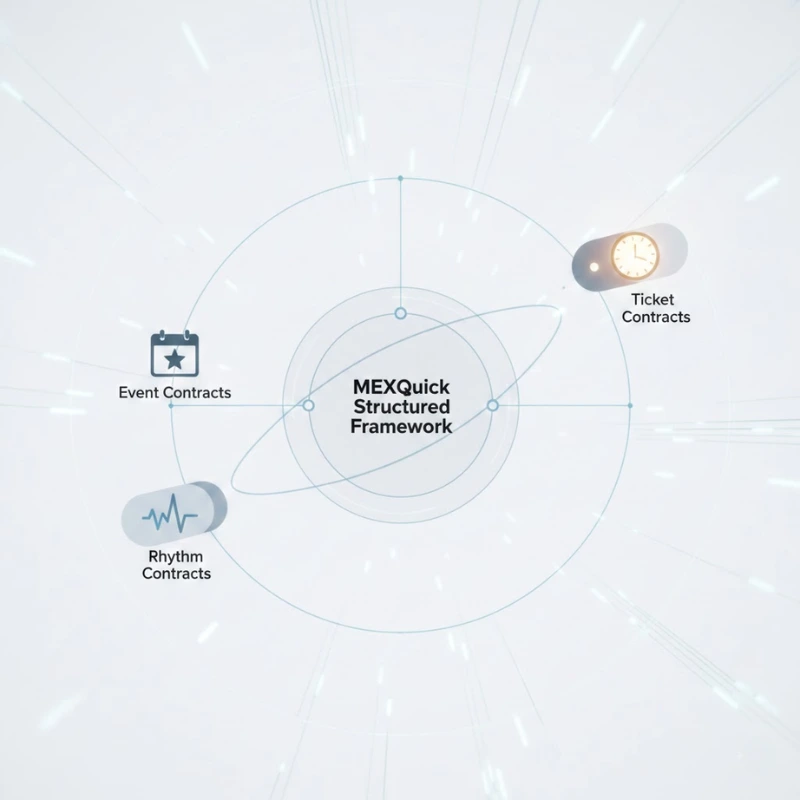
To understand where Ticket Contracts sit, it helps to look at the broader product framework. MEXQuick presents a suite of structured trading products, with Ticket Contracts being one specific offering. Understanding its neighbors in this ecosystem provides context for its design goals.
Event Contracts: These are typically highly specialized contracts designed to settle based on the outcome of a specific, one-off event (e.g., Will Asset X reach Price Y by Date Z?). They are binary in nature (settle to one of two outcomes) and are tied to singular catalysts.
Rhythm Contracts: While precise details may vary, Rhythm Contracts generally refer to products with a repeating, periodic structure—perhaps settling on a daily or weekly basis—allowing users to take a recurring position on market direction over standardized intervals.
Ticket Contracts fit between these as a generalized, short-cycle directional trading instrument. They are not tied to a specific external event like an Event Contract, nor are they necessarily bound to a rigid calendar rhythm. They are a flexible vehicle for taking a view on price action within a user-selected, short time window, with the defining characteristics of fixed cost and no liquidation.
The existence of multiple contract types serves different user intents:
Event Contracts cater to those with a strong view on a specific catalyst.
Rhythm Contracts cater to those who prefer a regular, systematic trading interval.
Ticket Contracts cater to those who wish to engage with short-term market movements in a simplified, risk-capped structure, without waiting for a specific event or calendar date.
This multi-product framework allows participants to choose the contract model that best aligns with their market perspective, time horizon, and risk management preference. Ticket Trading is positioned as the go-to model for discrete, short-term directional participation within a simplified mechanical framework.
Risk Considerations and User Suitability
A clear, unambiguous discussion of risk is the most critical part of any financial product explanation. Ticket Trading, while simplifying certain risk vectors, introduces and emphasizes others.
Primary Risk Considerations:
Market Volatility Risk: This is the principal risk. If the price of the underlying asset moves in the opposite direction to the user’s expectation during the contract’s lifecycle, the user will incur a financial loss. The shorter the contract duration, the more sensitive the outcome can be to sudden, volatile price spikes or drops.
Total Loss of Entry Cost: While the maximum loss is capped, it is important to internalize that the entire fixed entry cost can be lost. A contract expiring out-of-the-money results in a 100% loss of the committed funds on that ticket.
Short-Cycle Timing Risk: The time-bound nature is a double-edged sword. It provides clarity but also demands precision in market timing. Being broadly correct about direction but misjudging the timing window (e.g., the move happens just after the contract expires) still results in a losing outcome.
Dynamic Exposure Complexity: While the maximum risk is simple to understand, the path of the contract’s value during its life may be non-intuitive due to the dynamic exposure mechanism. Users should not assume a linear relationship between price movement and contract value, especially in the early stages of the contract.
Platform and Operational Risk: As with any digital asset platform, users are exposed to foundational risks including, but not limited to, systemic technical failures, cybersecurity breaches, or extreme market events causing disruptions. The integrity of the multi-source price oracle is also a critical dependency.
Risk is not removed in Ticket Trading — it is defined.
User Suitability Guidance:
Ticket Trading may be a suitable model for users who:
Understand cryptocurrency markets and short-term price dynamics.
Seek a defined, absolute maximum loss on a per-trade basis.
Prefer a simplified structure without the need to manage margin balances or liquidation prices.
Operate with a disciplined approach to position sizing, understanding that the fixed cost per contract is risk capital they are prepared to lose entirely.
Wish to express a short-term (minutes to hours) market view.
Ticket Trading is likely not suitable for users who:
Are new to financial markets or cryptocurrency volatility.
Cannot afford to lose the entire amount allocated to trading.
Seek long-term investment vehicles or passive holding strategies.
Prefer to use complex risk management tools like trailing stops or multi-legged options strategies within a single position.
Misinterpret the no liquidation feature as lower risk rather than differently structured risk.
The paramount rule: Users should only allocate capital they are fully prepared to lose. The fixed cost of a Ticket Contract is risk capital.
Important Clarifications and Misconceptions
Given its novel structure, it is essential to address common questions and misconceptions directly and factually.
“Is this gambling?”
No, it is a regulated financial trading product offered on an exchange platform. However, like all speculative trading, it involves risk and uncertainty. The key distinction from gambling is that the outcome is tied to the real-world price movement of a legitimate financial asset (cryptocurrency), derived from transparent, aggregated market data, not a random number generator or casino-style event. That said, treating it with a gambler’s mentality by chasing losses, trading without analysis, or risking essential funds, can make participation akin to gambling in practice.
“Is this binary options?”
No. Binary options have a fixed, all-or-nothing payout structure based on a simple yes/no condition (e.g., Price above $50,000 at 3 PM?). A Ticket Contract has a dynamic payout structure. While the maximum loss is fixed, the potential profit varies continuously based on how far the market moves in the favorable direction by the time of expiry. Its settlement value exists on a spectrum, not as one of two fixed amounts.
“Is the risk really unlimited?”
For the Ticket Contract buyer, risk is strictly limited to the fixed entry cost. This is a definitive, structural guarantee of the product. There is no scenario where a buyer loses more. (Note: This analysis addresses the buyer’s perspective. The risk structure for the issuer/seller of the contract, typically the exchange or liquidity provider, is a separate matter).
“Does ‘no liquidation’ mean I can just wait for the market to come back?”
Within the life of a single contract, yes, the position will not be closed early. However, if the market moves against you and the contract expires with the price out-of-the-money, it settles at a loss. You cannot “hold” a losing Ticket Contract hoping for a recovery beyond its expiry. The time boundary is absolute. This is a crucial difference from an underwater spot or futures position, which can be held indefinitely (though at the cost of margin or opportunity).
“Is this ‘better’ than futures trading?”
This is the wrong question. It is different. It is a simpler, bounded tool for a specific purpose: short-term, defined-risk participation. Futures are a more complex, flexible, and powerful tool for a wider range of strategies. The choice depends entirely on the user’s goals, skill level, and risk management preferences.
Frequently Asked Questions (FAQs)
The following questions address common operational concerns.
Can I exit a Ticket Contract before it expires?
No, Ticket Contracts are designed to be held until automatic settlement at the end of their predefined lifecycle. Unlike traditional spot or futures positions, there is no secondary market or early closure mechanism for individual Ticket Contracts. Once purchased, the contract will run its full course, with the outcome determined at expiry based on the settlement price. This structural feature emphasizes the importance of the time parameter and requires users to be comfortable with committing capital for the entire duration at the point of entry.
How is the profit or loss calculated at settlement?
The exact calculation follows a proprietary model, but the principle is grounded in the dynamic exposure mechanism. The contract’s payout is not a simple linear function of the price change. Instead, it is determined by how far the settlement price has moved in your favor (for a profit) or against you (for a loss) relative to the strike or reference price, with the effect of this movement weighted by the contract’s internal valuation model at expiry. Your maximum possible profit is variable and can be substantial, while your maximum loss is fixed at 100% of your entry cost. The platform will display the precise settlement value at contract maturity.
What happens if there is a price discrepancy or “flash crash” during the contract’s life?
The multi-source aggregated pricing mechanism is specifically designed to mitigate this risk. The settlement price is not taken from a single exchange at the exact expiry timestamp. It is derived from a volume-weighted aggregate across multiple major exchanges over a very short final calculation period (e.g., the last 30 seconds of the contract). This method smooths out anomalies, meaning a momentary “flash crash” on one exchange is unlikely to single-handedly determine the settlement outcome. The system aims to settle based on the consensus market price, enhancing fairness.
Are Ticket Contracts available for all cryptocurrencies?
No. Ticket Contracts are typically listed for major, high-liquidity cryptocurrencies (like BTC, ETH) that have deep, stable order books across multiple exchanges. This is a prerequisite for the integrity of the multi-source pricing model. Less liquid altcoins are generally not suitable for this short-cycle, price-sensitive product, as their prices are more prone to manipulation and extreme volatility on individual venues, which could compromise the reliability of the aggregated feed. Users should check the MEXQuick platform for the current list of supported underlying assets.
Is there a limit to how many Ticket Contracts I can purchase?
While there is no “leveraged” margin limit in the traditional sense, exchanges typically impose risk-based position limits or maximum exposure limits per user for any given contract series. This is a standard risk management practice to prevent excessive concentration and to ensure orderly settlement. The limit is usually defined in terms of the total notional value or the number of contracts. Specific details on position limits are outlined in the exchange’s official documentation and are visible within the trading interface.
Conclusion: Ticket Trading as a Structured Participation Model
Ticket Trading on MEXQuick, through its proprietary Ticket Contract, represents a deliberate attempt to re-architect short-term derivatives trading around the principles of predefined boundaries and mechanical simplification. It is a distinct category of contract, characterized by a fixed entry cost acting as the maximum loss, the complete absence of margin calls and liquidation mechanics, a strict time-bound lifecycle, and a dynamic exposure profile.
What it is: A structured vehicle for participating in short-cycle market movements with upfront clarity on worst-case loss. It is a tool for those who wish to engage with volatility within a rigidly defined risk and time frame, free from the administrative and psychological pressures of active margin management.
What it is not: It is not a leveraged futures or options variant. It is not a binary option. It is not a tool for long-term investing, and it is not a way to eliminate the fundamental risk of being wrong about market direction.
In fast-moving, volatile markets, structure matters. Ticket Trading provides one such structure, a framework that exchanges the infinite flexibility and attendant complexities of traditional leverage for a self-contained, expiration-bound trading unit with a known risk limit. For the educated user who understands its mechanics, respects its risks, and aligns it with a suitable trading strategy, it offers an alternative mode of market participation. As with all financial instruments, the ultimate responsibility lies with the user to conduct thorough research, comprehend the product fully, and never commit more than they can afford to lose. This article has aimed to provide the foundational knowledge necessary for that first critical step: understanding.