
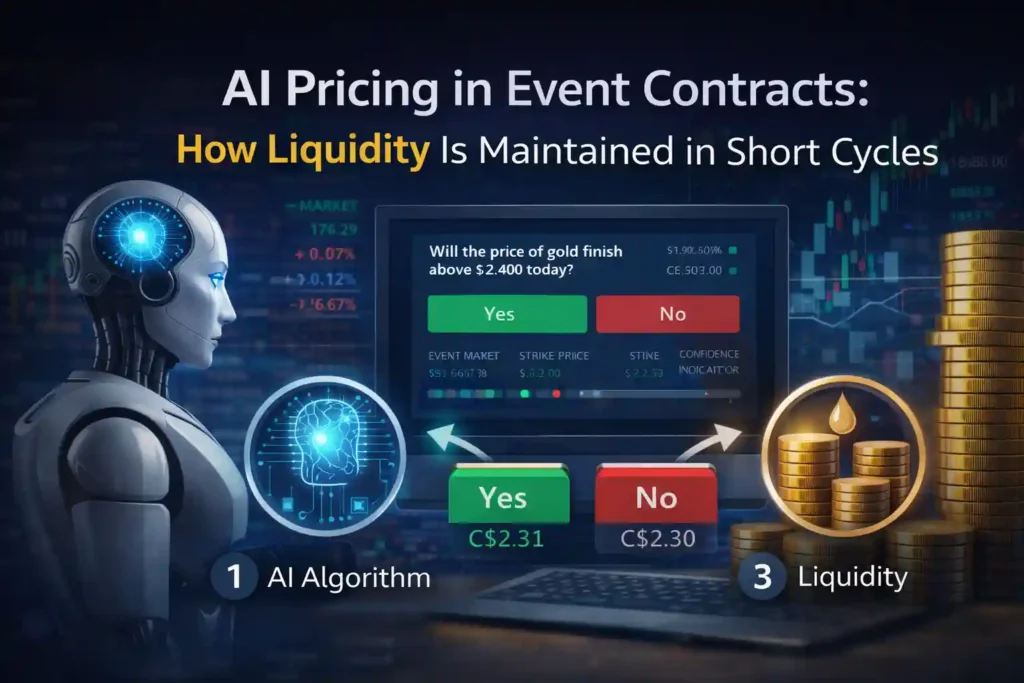
Event contracts move quickly, and sometimes they move too quickly for the usual market forces to keep up. Pricing can’t depend on slow order book depth or gradual price discovery when a product settles in minutes. It needs to always be available, responsive, and consistent. That’s where AI Pricing in Event Contracts comes in. Not just a buzzword, but a working system that keeps short-cycle markets open for business, even when prices are volatile and demand suddenly rises.
Why Short-Cycle Markets Make Liquidity Less Stable
In normal spot online trading, liquidity is mostly based on how many people are actively buying and selling. Price discovery happens all the time, and profits change based on how the market moves. Event contracts work in a different way. They are binary by nature, which means that users just guess whether the price will go up or down over a set period of time. At the end of that period, the contract automatically settles.
Liquidity can become weak when the time frame is shortened. If prices don’t keep up with market movement for even a few seconds, it can lead to stale quotes, unfair executions, or sudden trade breaks. In short cycles, even small problems become much worse. A pricing system that can change right away and keep the market going is necessary for a stable trading experience.
What AI Pricing Really Does for Event Contracts
In this case, Artificial Intelligence pricing doesn’t mean “predicting the future.” It is about always figuring out fair contract prices in real time, using structured inputs and risk logic to make sure trades can happen. The goal is realistic: keep the market open and balanced while the underlying asset moves quickly.
In short-cycle environments, the pricing engine has to keep answering the same question: what is a fair contract price right now, and how can the system keep providing liquidity without messing up prices? AI-driven pricing models help with this by keeping an eye on trade flow, responding quickly to changes in the market, and keeping things consistent even when conditions change.
Pricing and Managing Liquidity Are Shaped by Fixed Returns
Most of the time, event contracts have a set payout structure. That structure is easy for traders to understand, but it makes liquidity harder to manage behind the scenes.
This is how the profit structure works:
- If you guess right, you’ll get the investment amount plus a 90% fixed return.
- If you guess wrong, you lose all of your money.
- Handling fee: 10% flat rate, 50% off if you pay with MQT
The return is set, so the system needs to keep the market from getting too one-sided to protect liquidity. The platform’s exposure rises quickly when a lot of positions move in one direction, like a lot of “Up” positions. AI pricing helps keep things stable by changing how contracts are priced and offered. This way, the market can stay open and working without sudden freezes or strange shifts that would make execution impossible.
How AI Pricing Helps Keep the Market Open in Real Time
AI pricing helps keep liquidity in short cycles by using three main methods:
- Responding in real time
You need to keep getting updates for short-cycle trading. AI pricing systems keep updating contract prices all the time to stay in line with changes in the market. This lowers the risk of stale quotes and helps keep executions consistent. - Balancing flow and exposure
The market can become unbalanced when a lot of trades happen in one direction. AI pricing helps keep the system stable and tradable by changing the way prices are set based on the number of positions and the platform’s exposure. - Trust and consistency
Liquidity isn’t just about how easy it is to get; it’s also about how reliable it is. AI pricing helps keep pricing behavior based on rules and predictable, which makes people feel like pricing is fairer and less like it is random or unstable.
The Part That Fees Play in Keeping the Market Going
Fees aren’t just a way to make money; they also help keep the structure stable. The system adds a consistent cost layer with a fixed 10% handling fee. This can help stop ultra-high-frequency exploitation in a short-cycle environment. At the same time, offering a 50% discount for paying with MQT creates an incentive system without changing the contract’s simple fixed payout model.
This balance is important because it keeps the product clear and consistent for users, and it also keeps the system going even when participation levels and short-cycle volatility change.
Why AI Pricing Is More Important Here Than in Spot Trading
Spot markets can count on more people taking part and prices forming all the time. Event contracts, especially those with short cycles, need prices to stay the same over a short period of time and with set payout rules. Because of that combination, the product is very sensitive to how well it is made. AI pricing is what makes the contract tradable from start to finish, without making the price change too much, stop too often, or act in an unpredictable way.
The Bottom Line Is That Liquidity Is the Product
The appeal of event contracts is their speed, but that speed is also a limit. Prices must stay in line with what is happening in the market, liquidity must always be there, and execution must feel fair and stable. AI Pricing in Event Contracts is what makes that short-cycle experience work on a large scale. It is not an extra. It is what keeps markets moving, trades possible, and the product reliable when prices are at their highest.