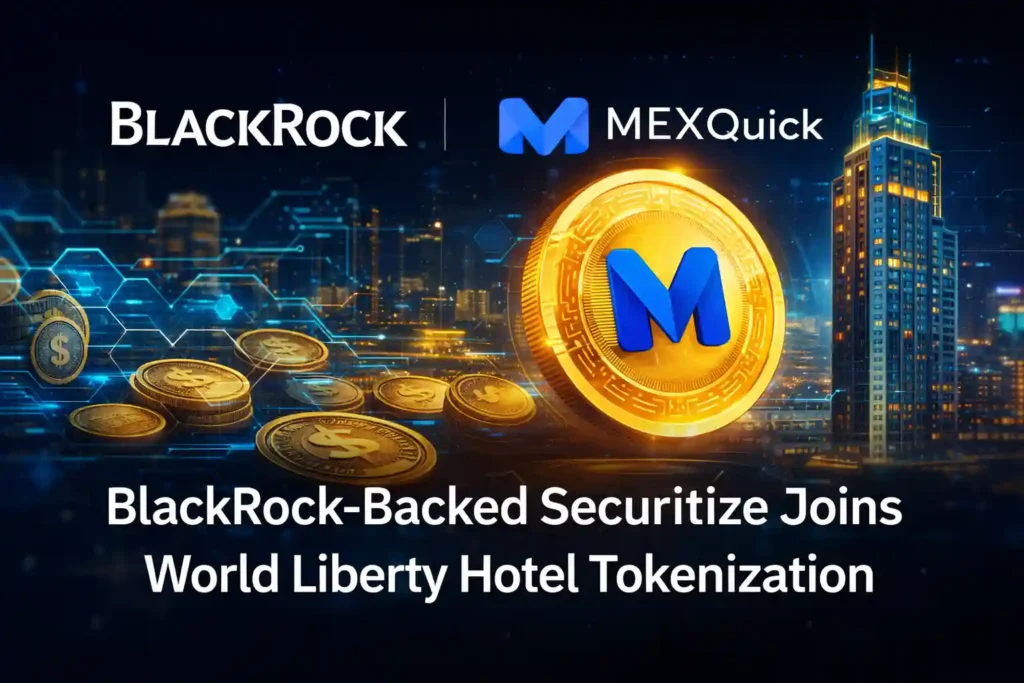
There is a clear shift going on in the capital markets. People don’t really talk about a hotel when Securitize, which is often called BlackRock-Backed Securitize, works with World Liberty Financial and DarGlobal on a hospitality project. It’s about structures. How finance works.
The main point of the announcement is to turn loan revenue interests from the Trump International Hotel & Resort in the Maldives into tokens. But there’s something more important behind the headline: a real-world example of institutional asset tokenization trying to work within a fully regulated framework, using compliant digital asset infrastructure instead of crypto-native improvisation. This isn’t about trying things out. It’s about building infrastructure that makes it easy for institutions to understand how to tokenize real-world assets (RWA).
The Framework That Made the Announcement Possible
The deal looks simple on the surface. They are paying for the building of a high-end hotel. Some of that money, specifically loan revenue interests, will be turned into digital securities and sold on the blockchain. The mechanics are more important than the marketing, though.
You don’t own part of a hotel room with the tokens. They are not timeshares with a Web3 wrapper around them. Digitizing a structured financial claim that is tied to the project’s loan economics. That means that the debt’s performance, not the hotel’s day-to-day operations, is what makes money for investors. This difference makes it clear that the product is for digitizing financial assets, not for tokenizing real estate for consumers. And that difference is what makes the rules for it.
Regulation D in the US and Regulation S offshore make it possible for only accredited or otherwise qualified investors to take part in the offering. There are rules about transfers. If there is secondary liquidity, it would only work within certain rules.
This is not “open mint, trade anywhere.”
There are rules about issuing tokens. That’s the point.
Why Securitize, with BlackRock’s Help, Is Important
There is meaning to the phrase “BlackRock-Backed Securitize” because institutions know what it means. Securitize is a regulated digital securities platform that serves as a broker-dealer, transfer agent, and alternative trading system. It works as a compliance layer between blockchain infrastructure and traditional securities law. Placement is very important. Tokenizing real-world assets doesn’t fail because it’s hard to write smart contracts. When regulators look into compliance, custody, reporting, or transfer restrictions and they don’t work, it fails.
Securitize has already been linked to on-chain asset management projects that involve big names in the field. People look at projects like this one differently because of that trust. It changes them from trying out DeFi to working in structured capital markets. If institutional asset tokenization wants to grow, it needs to be right there.
Institutional Asset Tokenization: From Concept to Application
For a long time, people talked about tokenization in terms of what could happen. Real estate that is divided into parts. Private equity that can be traded. Digital bonds. It wasn’t demand that kept people from using it; it was coming together. Institutions need digital asset infrastructure that meets standards. They need clear rules for issuing securities, checking investors, reporting, and moving assets. They need to issue securities on the blockchain in a way that works with existing compliance frameworks, not in a way that goes around them.
This project demonstrates the transition from theoretical concepts to practical application. Here’s a list of the roles that are involved in an organized way:
Table 1: Important People and What They Do
| Person who took part | Part of the Structure | Functional Contribution |
| World Liberty Financial | Setting up and sending out products | Creates the RWA offer with the WLFI brand |
| DarGlobal | Real estate builder | Gives the project and the way it is funded that supports it |
| Securitize | A regulated digital securities platform | Handles issuing that follows the rules, bringing in new investors, and keeping track of transfers |
| The Trump Company | Brand licensor | Links the hospitality project to a well-known brand |
Tokenizing Real-World Assets (RWA) in the Real World
Tokenizing real-world assets can sound very abstract. In reality, it’s just a digital version of a legally recognized claim to money. Traditional law still applies to the underlying asset. The record-keeping layer and maybe the speed of issuing and settling are what change. In this case, the token stands for exposure to loan revenue interests. Smart contract securities keep track of who owns what, make sure that transfers are limited, and handle payments. This method combines regulated issuance with programmable settlement. It doesn’t get rid of compliance; it adds it to the code.
The difference is small, but it’s very important.
Table 2: Putting Out Digital Security vs. Starting Up Traditional Crypto
| How big | Model of Security with Tokens | Standard Crypto Token Model |
| Legal Classification | Set up according to exceptions in securities law | Often framed in terms of usefulness (this changes from place to place) |
| Investors Can Get In | Only people who are accredited or qualified can take part | Often open to participation from retailers |
| Controls for Moving | Enforced by rules and smart contracts that everyone has to follow | Most of the time, you don’t need permission |
| Reporting that doesn’t stop | Required disclosures and oversight of administration | Not much, unless it’s classified as security |
| Layer of Settlement | On-chain but limited by compliance | Settlement on a fully open blockchain |
The Future of On-Chain Asset Management
An interesting part of the announcement makes it sound like there are bigger plans. There are hints about possible future on-chain utilities, like being able to use holdings as collateral in WLFI-linked markets, as long as the rules let it. This is where tokenization starts to move from just making things digital to putting them all together.
On-chain asset management envisions regulated digital securities working together in programmable financial environments. All of these things are legal: collateralization, automatic yield distribution, and conditional transfers. If done right, this will connect institutional finance to blockchain infrastructure.
If not done right, it becomes a problem for regulators.
Execution will decide which way it goes.
The Challenge of Real Estate Tokenization
People have been saying for a long time that tokenizing real estate would be a great idea. It costs a lot to start, is in high demand all over the world, and is usually hard to sell.
But it has also been hard to grow. It’s not easy to understand ownership structures. Taxes are handled differently in different places. There are different levels of regulatory oversight around the world. Just because something is on a blockchain doesn’t mean it can be traded for cash.
This project tries to fix those problems by focusing on financing exposure instead of owning property directly. By digitizing structured loan revenue interests, the model gets around some of the problems that come with property title fragmentation. It resembles tokenized credit rather than tokenized physical assets.
Table 3: Opportunities and Challenges in Institutional RWA Tokenization
| Opportunity | Structural Limitation |
| Issuance and settlement happen faster | There may still not be enough liquidity |
| Global investor reach (who can take part) | Difficulty of following the rules in a certain area |
| Payments that can be set up | The dangers of smart contracts and running a business |
| Easy management of the cap table | Responsibilities of regulatory oversight |
| Possible use of collateral | Limited environment for transfer |
Changes in the Market and the Digitalization of Financial Assets
The main point here is that financial assets are going digital. The infrastructure of capital markets is slowly getting blockchain features. Not going to take the place of exchanges right away. Not getting rid of the old custodians. But adding programmable settlement where it helps things run more smoothly.
One way to get there is through Securitize, which is backed by BlackRock. It works as a compliant bridge, which means that projects like this can happen without breaking any rules right away. The name of the brand won’t matter as much as how well it works. Yield that stays the same. How reliable reports are. The law is clear. Institutions do what they think they should.
The Effect Over Time
This announcement fits into a pattern that is becoming clearer. Institutional asset tokenization is moving away from guesswork and toward planned use. Issuing tokens in a way that follows the rules. Smart contract securities that work in some situations. Instead of being separate from compliance frameworks, blockchain-based securities issuance should be a part of them.
If projects like this work well in the real world, with money moving around, accurate reporting, and protections for investors, we will probably see similar structures used for other types of real-world assets, like private credit, infrastructure debt, structured funds, and even tokenized private equity vehicles.