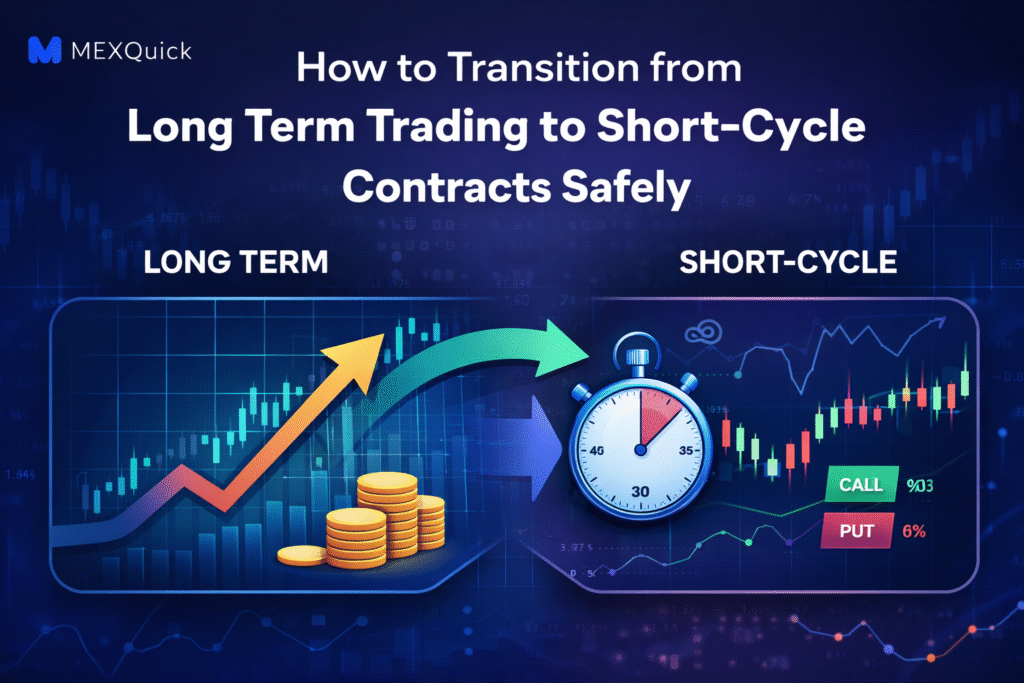
There is a particular calm that comes with long term trading. You build a thesis, study cycles, allocate capital with intention and accept that time will do part of the work for you. Markets breathe in and out, and you give them space to do it. Then one day you decide to explore short-cycle contracts, and suddenly that calm doesn’t feel as useful.
The charts move faster. Decisions feel compressed. The margin for error narrows. What used to be a patient, structured long-term investment strategy begins to feel almost too slow for the environment. It’s not that your previous approach was wrong. It’s that it was built for a different tempo.
Transitioning safely from long-term trading into short-cycle contracts is not about abandoning one philosophy for another. It is about understanding that you are moving between two distinct market mechanics, and if you treat them as the same, the market will correct you very quickly.
The Psychological Shift: From Patience to Precision
A trader operating within a buy and hold strategy or even structured position online trading develops a specific psychological posture. You think in months, sometimes years. Your long-term market outlook is informed by macro conditions, earnings cycles, liquidity trends, and structural growth themes. You rely on fundamental analysis investing and macro trend alignment to support your exposure.
In that world, patience is not only rewarded—it is required.
Short-cycle contracts function differently. The edge does not primarily come from long-range conviction. It comes from timing, execution quality, and the discipline to invalidate quickly. A trade that moves against you does not get “room to breathe” because the entire premise of short-cycle structure is based on compressed movement. The most difficult adjustment for experienced long-term traders is this: you must replace patience with precision. Your experience is still valuable, but it must be applied differently.
Structural Differences Between Long-Term Trading and Short-Cycle Contracts
The transition becomes easier when you clearly understand the structural distinctions between the two approaches. The danger lies in assuming that short-cycle trading is simply long-term trading on a smaller chart. It is not.
Below is a comparative breakdown that illustrates how the mechanics differ.
Table 1: Structural Comparison
| Category | Long-Term Trading | Short-Cycle Contracts |
| Decision Horizon | Weeks to years | Minutes to hours |
| Core Strategy | Long-term investment strategy, macro trend investing | Tactical execution within short structural windows |
| Primary Edge | Fundamental analysis investing and macro positioning | Timing, liquidity awareness, disciplined invalidation |
| Risk Management | Thesis-based exposure adjustment | Strict stop-based containment |
| Emotional Pressure | Slow, thesis-driven uncertainty | Immediate performance feedback |
When you examine the table carefully, one thing becomes clear. The edge in long term trading is narrative-based and structural. The edge in short-cycle contracts is mechanical and execution-based. That is not a small distinction. It changes everything from trade frequency to psychological load.
Redesigning Risk: The Foundation of a Safe Transition
If there is one area that requires complete reconstruction during this transition, it is risk management. Within long-term portfolio management, capital is typically allocated according to strategic weightings. A strong thesis may justify larger exposure within your strategic asset allocation model. Temporary drawdowns are acceptable because the expectation is long-term capital growth.
Short-cycle contracts do not allow that cushion. In this environment, risk must be predefined and non-negotiable. The question shifts from “Do I still believe in this asset?” to “Has my setup been invalidated?” The sizing model must shrink accordingly. Exposure is calculated based on invalidation distance and volatility, not conviction. Below is a practical progression model that allows you to build competence without exposing your capital unnecessarily.
Table 2: Phased Risk Transition Model
| Phase | Objective | Risk Per Trade | Focus |
| Phase 1 | Observation and structural learning | 0% (simulation or micro) | Pattern recognition and rule development |
| Phase 2 | Emotional conditioning under live conditions | 0.10%–0.25% | Stop discipline and execution control |
| Phase 3 | Process stabilization | 0.25%–0.50% | Consistency and trade selection |
| Phase 4 | Gradual scaling | 0.50%–1.00% | Performance stability under size |
This staged approach protects the integrity of your broader wealth accumulation strategy while allowing short-cycle skills to develop gradually. The mistake many traders make is skipping directly to higher exposure levels because they assume previous market experience transfers fully. It does not.
Maintaining Separation: Protecting Your Long-Term Capital Base
One of the most important safeguards during this transition is structural separation between long-term investments and short-cycle capital. If you already operate a disciplined long-term portfolio management framework designed around long-term capital growth, that structure must remain insulated. Your buy and hold strategy, your macro thesis allocation, your strategic weightings — they should not be influenced by short-cycle outcomes.
Combining the two introduces emotional leakage. A short-term loss should not affect a macro allocation. A short-term win should not encourage overconfidence in long-term positioning. Operational separation creates clarity.
In practice, this often means separate accounts, separate performance tracking, and separate performance metrics. Long-term investing is evaluated over quarters and years. Short-cycle trading is evaluated over execution consistency and risk containment. They serve different purposes within your overall financial architecture.
Reframing Decision-Making: From Forecasting to Invalidation
Long-term trading thrives on forecasting on MEXQuick. You evaluate economic cycles, interest rate trajectories, sector rotation, liquidity flows, build a thesis around macro trend investing and assess how assets align with your long-term market outlook.
Short-cycle contracts require a different lens.
The primary question is no longer “Where is this asset going over the next year?” It becomes “At what point is this setup clearly invalid?”
This subtle shift restructures your thinking. Instead of predicting, you define boundaries. Instead of defending positions, you enforce conditions. When invalidation becomes the center of decision-making, risk stabilizes. Emotional interference decreases. You stop negotiating with the market. That discipline is what allows short-cycle trading to coexist safely alongside long-term trading.
Building a Structured Short-Cycle Playbook
A professional transition requires written structure. Improvisation is expensive in fast markets.
Your short-cycle playbook should not be extensive. In fact, the more limited it is initially, the better. Restrict your asset selection. Define the hours you are willing to trade. Clarify what constitutes a valid setup. Write down your exit logic.
A simplified structural template might look like this:
Table 3: Short-Cycle Playbook Framework
| Component | Definition |
| Market Selection | Limit to 1–3 highly liquid instruments |
| Session Window | Trade only during defined high-liquidity hours |
| Setup Criteria | Clear structural alignment before entry |
| Invalidation Rule | Predefined structural breach triggers exit |
| Profit Management | Partial realization and trailing structure |
| Daily Stop Limit | Fixed loss threshold before stopping |
The strength of this framework is not complexity. It is constraint. Constraints reduce emotional overreach and prevent overtrading — one of the most common pitfalls during transition.
Leveraging Your Long-Term Strengths Without Misapplying Them
Your background in long-term trading is not a liability. It is an advantage if applied correctly.
Your understanding of macro cycles, valuation context, and structural market behavior can help you filter short-cycle opportunities. If your long-term market outlook suggests elevated volatility due to macro catalysts, you can adjust accordingly. If a macro thesis supports directional bias, you can use it as contextual alignment.
What you cannot do is allow that macro conviction to override short-cycle invalidation.
Macro alignment informs bias. It does not excuse poor trade management.
When that boundary is respected, your experience compounds rather than conflicts.
The Balanced Outcome: Two Complementary Modes
When managed carefully, short-cycle contracts do not replace long-term trading. They complement it. Your long-term investment strategy continues to serve as the foundation for capital preservation and growth. Your strategic asset allocation and macro exposure remain aligned with your wealth accumulation strategy. Short-cycle contracts become tactical tools. They allow you to engage volatility intentionally rather than passively endure it.
The key is progression. Controlled sizing. Written structure. Clear separation. Respect for invalidation. Transitioning safely is not about speed. It is about stability. If you approach it as skill expansion rather than identity replacement, you protect your long-term capital base while developing a second operational gear. And in markets that constantly shift between slow structural cycles and rapid volatility bursts, having both gears — used deliberately — is often what defines durable performance.