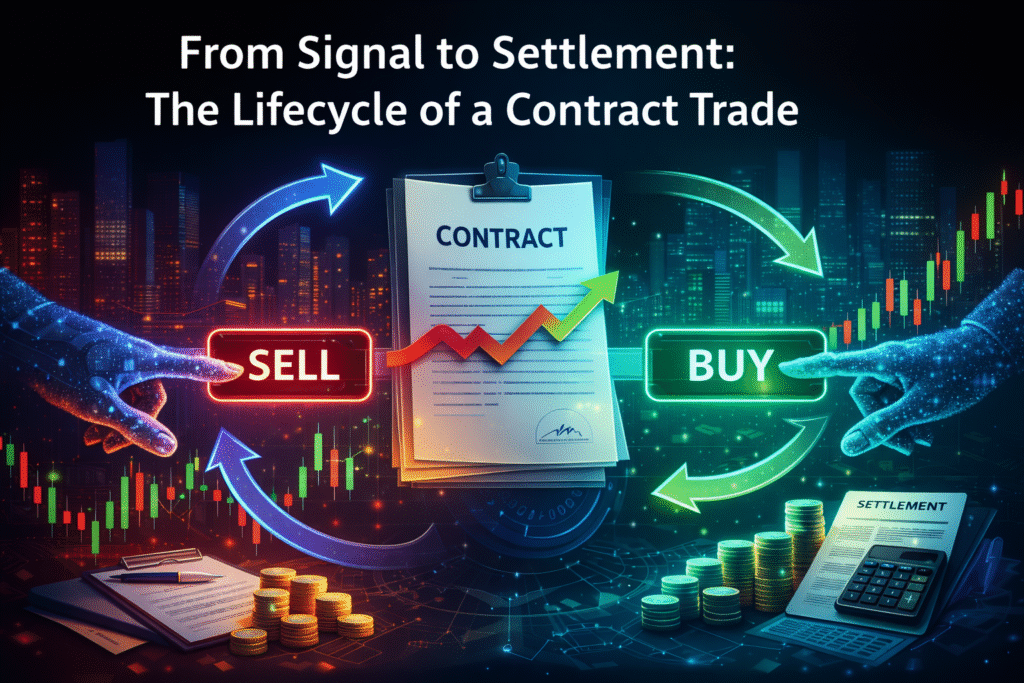
Every contract trade starts prior to the order being placed. It starts with observation, that fleeting instant when market behavior changes enough to be worth taking notice of. Fractures occur at a resistance level. Momentum hesitates. Liquidity gets tighter. The volatility is introduced by a macro release. The signal is rarely loudly announced; instead, it develops gradually, and seasoned traders recognize it as possible structure forming rather than excitement.
The trade proceeds through a specified progression from that first signal. Entry comes after purpose. There is risk associated with exposure. Management is necessary for risk. Either structural settlement or active exit will ultimately bring the position to an end. The lifecycle’s architecture doesn’t change, even in short-term contracts where the full cycle could be completed in a matter of minutes. The only difference is the compression of time. It is not theoretical to comprehend the lifecycle of a contract trade. It is the structure that distinguishes between organized and spontaneous continuous trading.
What a Contract Trade Is?
In its most basic form, a contract trade is an arrangement whose value is determined by changes in the price of an underlying asset. The trader invests in an instrument that mimics or references the performance of the asset rather than buying and holding it directly. In this sense, ownership is replaced by exposure.
This structure allows for flexibility when online trading derivatives. Standardized agreements with specified expiration dates are offered by futures contracts. Rights-based exposure is introduced through options trading, which takes time decay and strike prices into account. With broker-issued contracts, CFD trading permits price speculation. Perpetual contracts, which are becoming more and more prevalent in digital asset markets, do away with expiration completely and use funding mechanisms to fix contract prices to the spot market.
Trading contracts follow the same logic for all instruments. The ability to hedge, directional exposure, capital efficiency, and the ability to take both long and short positions without actually holding the asset are all desirable to traders. However, complexity does not decrease when ownership is absent. It elevates it. The risk environment is determined by the mechanisms incorporated into the contract.
A Structural Difference between Spot and Contract Trading
Contract and spot trading differ in terms of risk architecture rather than just product type. In spot trading, ownership is simple. A trader purchases and keeps an asset. Price depreciation is the main danger. The mechanism for liquidation does not exist. zero margin for maintenance. no structural expiration.
This dynamic is changed through contract trading. Using a derivative agreement, the trader assumes exposure even though they do not own the asset. Contract instruments often contain leverage, which magnifies price movements. Both vulnerability and profit potential are increased by this amplification. Price direction is not the only factor that influences losses; margin requirements, funding rates, liquidation thresholds, and settlement rules all play a role.
This difference is made clear by the following structural comparison:
| Feature | Spot Trading | Contract Trading |
| Ownership | ownership of the asset directly | exposure through a derivatives contract |
| Leverage | Common Leverage (Margin Trading) | |
| Shorting | Limited accessibility | Integrated capabilities |
| Expiry | No expiration date | product-dependent |
| Risk Structure | Mechanisms of price movement | price + margin + liquidation |
It is crucial to comprehend this difference prior to engaging in any contract trade. The laws pertaining to ownership and exposure are significantly different.
The Contract Trade’s Lifecycle
Intention is the first step in a contract trade, and settlement is the last step. This progression is not abstract or optional. The structural facts of trading derivatives are reflected in it.
The signal generation, setup planning, margin allocation, execution, exposure management, exit or expiry, and final settlement are the typical stages that make up the lifecycle. There are risk factors unique to each stage. When one is neglected, friction is introduced throughout the entire structure.
Step 1: The Signal
The signal serves as a contract trade’s intellectual foundation. It could be the result of changes in liquidity, order flow behavior, macroeconomic developments, or technical structure. No matter where it comes from, it is the rationale for taking a risk.
Breakouts, trend continuations, or volatility expansion are common ways that technical signals manifest themselves. Earnings reports, monetary policy decisions, or more general changes in market sentiment can all produce fundamental signals. Changes in funding or open interest rates may offer more information about positioning imbalances in leveraged settings like perpetual contracts or futures contracts. But the signal is just an invitation. The results are not assured. It starts the analysis process.
Step 2: Preparation
Observation is converted into structured intent during the setup phase. The trader has to decide which instrument fits the goal before assuming exposure. A perpetual contract subject to funding adjustments behaves differently than a futures contract with a defined expiry. Options trading completely changes the nature of risk by introducing time decay and nonlinear payoffs. Broker-specific cost structures that affect holding duration may be a part of CFD trading.
Clarifying directional bias is also necessary. When prices move higher, a long position gains, and when they move lower, a short position gains. Despite their structural opposites, each can have very different liquidity and behavior dynamics. It is essential that invalidation be defined prior to execution. What is the trade thesis’s weakness? Leverage turns uncertainty into increased loss when this clarity is lacking.
Thus, leverage selection stops being an emotional whim and instead becomes a conscious decision. Capital efficiency is improved with moderate leverage. Tolerance for normal volatility is diminished by excessive leverage. This tolerance becomes even more constrained in short-term contracts, where time compression increases price sensitivity. A properly designed setup guarantees that the trade is defined before the market does.
Step 3: Mechanics of the Margin
The foundation of contract trading is margin. It establishes how much collateral backs the position and how resistant the trade is to unfavorable movement. Cross margin mode offers flexibility but increases systemic exposure because the available account balance supports all open positions collectively.
It is crucial to comprehend margin terminology:
| Term | Definition | Structural Impact |
| The starting margin | Required collateral to open a position | determines the size of the position |
| Margin for Maintenance | Minimum collateral required to maintain the position | controls the liquidation threshold |
| Separated Margin | Position-specific collateral | reduces exposure to a single trade |
| Margin of Crossing | Collateral from a shared account | Enhances adaptability and overall risk |
The difference between the initial and maintenance margins has a direct impact on the likelihood of liquidation. Survival in leveraged trading frequently hinges more on margin discipline than entry accuracy.
Step 4: Implementation
Slippage rises and spreads widen in volatile environments. Because forced liquidations can momentarily skew price behavior, leveraged markets magnify these microstructural factors.
Execution is more than just mechanical. It displays the trader’s preferred method of interacting with liquidity. Every choice affects where the trade begins in its lifecycle.
Step 5: Handling Exposure
A contract trade’s most psychologically taxing stage begins once it is active. The trader must react within predetermined parameters as the market changes without regard to intention. Depending on positioning, funding rates in perpetual contracts can add extra cost or benefit. Thus, holding time influences the final result. Basis convergence becomes important in futures contracts that are about to expire. Time erodes extrinsic value in options trading, changing risk-reward dynamics on a daily basis.
In leveraged trading, volatility becomes especially important. If margin tolerance is inadequate, short-term price spikes may cause liquidation even in cases where directional bias is accurate. This fact emphasizes how crucial conservative leverage and controlled invalidation levels are. When structural conditions shift, exposure management may entail modifying stop placement, scaling partial profits, or closing early.
Step 6: Leave, Expire, or Work Out
Contract trades end in accordance with the guidelines of the instrument. Usually, CFD positions close manually or according to preset risk criteria. Until the trader decides to terminate them, perpetual contracts stay open indefinitely.
Step 7: Conciliation
The contract trade lifecycle’s accounting climax is settlement. Profit and loss are now realized. They deduct fees. There are funding adjustments that’s why the margin is freed.
The lifecycle can be structurally summarized as follows:
| Stage | Description | Key Risk Focus |
| Signal | Trade catalyst identified | Context and volatility |
| Establishment | Planning for structures | Leverage and invalidation |
| Margin | Allocation of Collateral | Limits of liquidation |
| Execution | Entering the market | Slippage and Spread |
| Management | Controlling exposure actively | Finances and fluctuations |
| Leave/Expiration | Conclusion of the position | Time and organization |
| Settlement | P&L finalization | Costs and actual results |
Conclusion
A moment does not exist in a contract trade. There is a sequence. Every stage, from the first signal to the last settlement, has structural ramifications that influence the final result. Disciplined lifecycle management is more important for durability in derivatives trading than forecasting, whether through futures contracts, options trading, CFD trading, or perpetual contracts. Contract trading becomes structured decision-making when viewed as a procedure as opposed to a transaction. Furthermore, structure is essential in leveraged markets. It’s the distinction between volatility as risk and volatility as opportunity.