100x Leverage in Crypto How It Works and Why Risk Control Matters

Top 20 Coins
Click on coin symbol for more information.
Daily Winners/Losers
Click on coin symbol for more information.

In the world of cryptocurrency trading, 100x leverage represents both extraordinary opportunity and significant risk. This powerful financial tool allows traders to control positions 100 times larger than their initial capital, potentially magnifying returns dramatically. However, the same mechanism that can multiply profits can just as quickly lead to account liquidation. Understanding the mechanics of 100x leverage crypto trading is essential before deploying this advanced strategy. MEXQuick is committed to providing comprehensive educational resources that help traders make informed decisions about leverage use, emphasizing that knowledge and risk management must come before application.

What Does 100x Leverage Mean in Crypto Trading

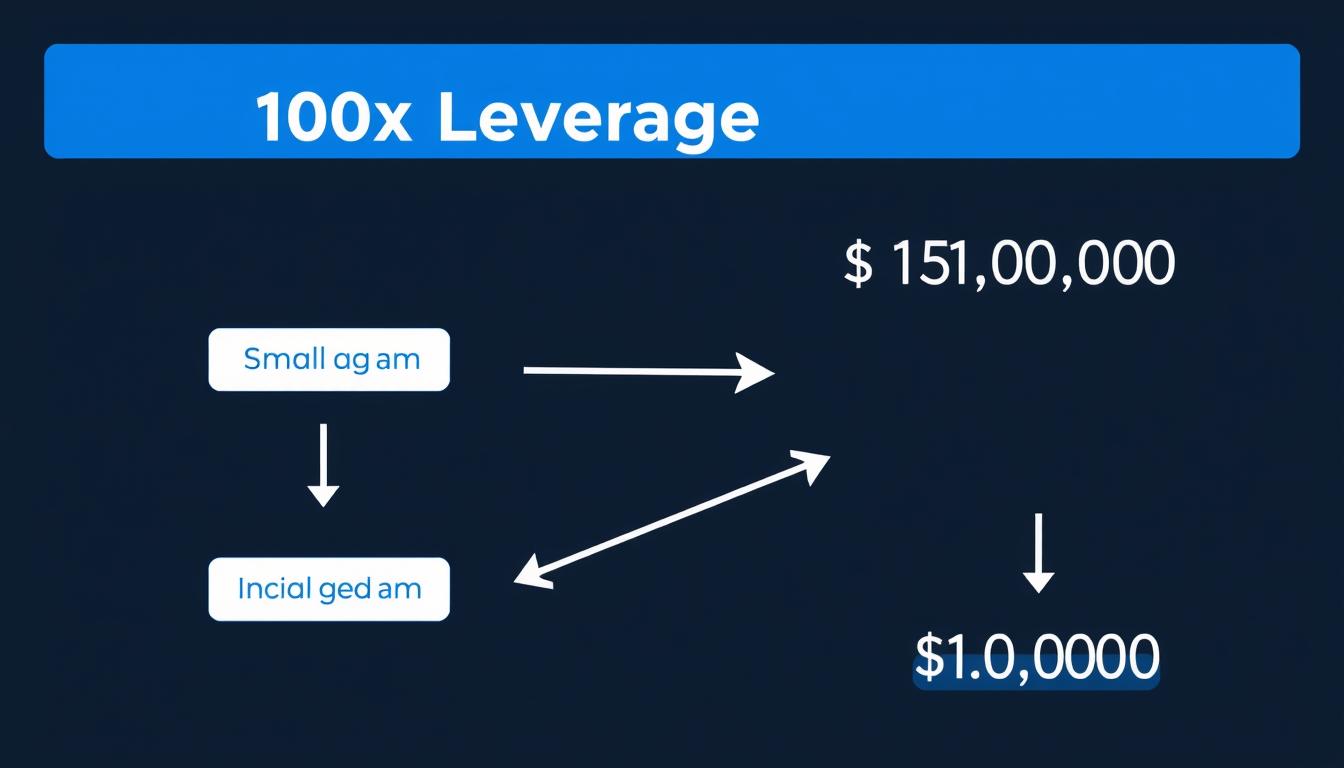
100x leverage crypto trading diagram showing $100 controlling $10,000 position

Visualization of how $100 initial margin controls a $10,000 position with 100x leverage

Leverage in cryptocurrency trading functions as a capital multiplier, allowing traders to open positions larger than their available funds. When a platform offers 100x leverage, it means you can control a position worth 100 times your initial investment. For example, with just $100 of capital, you can open a $10,000 position in Bitcoin, Ethereum, or other cryptocurrencies.

This amplification occurs because the exchange essentially lends you the additional funds needed to open the larger position. Your initial capital serves as “margin” or collateral for this loan. With 100x leverage, you’re only required to put up 1% of the total position value as margin (1/100 = 0.01 or 1%).

It’s crucial to understand that leverage doesn’t change the underlying market dynamics or increase the probability of profitable trades. The market still moves by the same percentage, but the effect on your position is magnified proportionally to your chosen leverage.

How 100x Leverage Differs from Lower Multiples

The difference between trading with 100x leverage versus lower multiples like 10x or 5x lies primarily in the margin requirements and risk exposure:

Leverage MultipleMargin RequirementPosition Size per $100Price Move for Liquidation
5x20%$500~20% against position
10x10%$1,000~10% against position
50x2%$5,000~2% against position
100x1%$10,000~1% against position

Higher leverage means you can control larger positions with less capital, but it also means smaller adverse price movements can trigger liquidation. With 100x leverage, a mere 1% move against your position can result in a total loss of your margin.

How Margin and Liquidation Work (with Simple Calculation Example)

100x leverage crypto liquidation price calculation diagram

Liquidation price calculation for 100x leveraged positions

Understanding margin and liquidation mechanics is crucial when trading with 100x leverage crypto. These concepts form the foundation of leveraged trading and directly impact your risk exposure.

Initial Margin and Maintenance Margin

When opening a leveraged position, you must provide an initial margin as collateral. With 100x leverage, this initial margin requirement is typically 1% of the total position value. For example, to open a $10,000 Bitcoin position with 100x leverage, you need $100 as initial margin.

Exchanges also set a maintenance margin requirement—the minimum amount of equity you must maintain to keep your position open. If your equity falls below this threshold due to adverse price movements, the exchange will initiate liquidation to prevent further losses.

Liquidation Mechanics Explained

Liquidation occurs when your position’s losses approach or exceed your margin. For 100x leverage positions, this typically happens when the market moves approximately 1% against your position. The exact liquidation price depends on several factors, including:

  • Entry price of your position
  • Size of your position
  • Amount of margin provided
  • Fees and funding rates
  • The exchange’s liquidation buffer

Liquidation Price Calculation Example

Let’s walk through a practical example of how liquidation price is calculated for a 100x leveraged long position:

Suppose you open a long position on BTC/USDT with 100x leverage:

• Entry Price: $50,000 per BTC
• Position Size: 0.2 BTC (worth $10,000)
• Initial Margin: $100 (1% of position value)
• Exchange Liquidation Buffer: 0.5% (varies by platform)

Liquidation Price = Entry Price × (1 – (Initial Margin / Position Value) + Liquidation Buffer)

Liquidation Price = $50,000 × (1 – ($100 / $10,000) + 0.005)

Liquidation Price = $50,000 × (1 – 0.01 + 0.005)

Liquidation Price = $50,000 × 0.995 = $49,750

In this example, if the price of Bitcoin falls to $49,750 (just 0.5% below your entry), your position would be liquidated, and you would lose your entire $100 margin. This demonstrates how even small price movements can lead to total loss when trading with 100x leverage.

Important: Most exchanges don’t wait until your equity reaches zero before liquidating. They typically initiate liquidation when your equity approaches the maintenance margin requirement to ensure they can close the position without incurring losses themselves.

Cross vs Isolated Margin — Controlling Exposure

Cross vs Isolated Margin comparison for 100x leverage crypto trading

Comparison of cross margin vs isolated margin risk exposure

When trading with 100x leverage crypto, exchanges typically offer two margin modes: cross margin and isolated margin. Each approach has distinct implications for risk management and capital efficiency.

Cross Margin: Shared Collateral Pool

In cross margin mode, your entire account balance serves as collateral for all open positions. This approach offers several advantages:

  • Efficient capital utilization as all available funds help maintain positions
  • Automatic transfer of profits from winning trades to support losing positions
  • Lower likelihood of liquidation as long as your overall account has sufficient equity

However, cross margin also presents significant risks, particularly with 100x leverage:

  • Your entire account balance is at risk if positions move against you
  • Difficult to compartmentalize risk between different trading strategies
  • Challenging to track performance of individual positions

Isolated Margin: Compartmentalized Risk

Isolated margin mode assigns a specific amount of collateral to each individual position. This approach offers better risk control:

  • Maximum possible loss is limited to the margin allocated to each position
  • Easier to implement different strategies with varying risk levels
  • Clearer performance tracking for individual positions

The drawbacks of isolated margin include:

  • Less efficient capital utilization
  • Higher likelihood of individual position liquidations
  • Requires more active management of margin levels
FeatureCross MarginIsolated Margin
Risk ExposureEntire account balanceLimited to allocated margin
Capital EfficiencyHigherLower
Liquidation RiskLower for individual positions, but can affect entire accountHigher for individual positions, but contained
Position ManagementSimpler (automatic)More hands-on
Recommended ForExperienced traders with correlated positionsBeginners or traders with diverse strategies

Choosing the Right Margin Mode for 100x Leverage

When trading with extreme leverage like 100x, isolated margin is generally recommended, especially for beginners. This approach ensures that a single unsuccessful trade won’t compromise your entire trading account. As you gain experience and develop more sophisticated strategies, you might consider cross margin for specific scenarios where positions hedge each other.

MEXQuick Tip: When using 100x leverage, consider starting with isolated margin and allocating no more than 1-2% of your total trading capital to any single position. This approach helps prevent catastrophic losses while you develop your trading strategy.

Funding Rates, Fees, and Exchange Risk Models

Funding rates and fees impact on 100x leverage crypto positions

How funding rates and fees affect 100x leveraged positions over time

When trading with 100x leverage crypto, understanding the cost structure is crucial. Various fees and funding mechanisms can significantly impact your profitability and liquidation risk, especially at high leverage multiples.

Trading Fees and Their Impact on Leverage

Most cryptocurrency exchanges employ a maker-taker fee model for leveraged trading:

  • Maker fees: Charged when you add liquidity to the order book (limit orders that don’t execute immediately)
  • Taker fees: Applied when you remove liquidity from the order book (market orders or limit orders that execute immediately)

With 100x leverage, even small fees have an amplified effect on your margin. For example, a 0.05% taker fee on a $10,000 position costs $5, which represents 5% of your $100 margin when using 100x leverage. This immediately reduces your liquidation buffer, bringing the liquidation price closer to your entry price.

Perpetual Futures and Funding Rates

Most 100x leverage trading occurs on perpetual futures contracts, which have no expiration date. To keep perpetual futures prices aligned with the spot market, exchanges implement a funding rate mechanism:

  • Funding occurs periodically (typically every 8 hours)
  • When the perpetual price is higher than the index (spot) price, long positions pay short positions
  • When the perpetual price is lower than the index price, short positions pay long positions
  • Funding rates are expressed as a percentage and applied to the notional value of your position

With 100x leverage, funding rates can quickly erode your margin or enhance your returns. For instance, a 0.01% funding rate on a $10,000 position equals $1, which is 1% of your $100 margin. If you’re paying funding rather than receiving it, this further reduces your liquidation buffer.

Fee TypeTypical RangeImpact on $10,000 Position (100x Leverage)Percentage of $100 Margin
Maker Fee0.01% – 0.02%$1 – $21% – 2%
Taker Fee0.04% – 0.06%$4 – $64% – 6%
Funding Rate (8-hourly)-0.01% to +0.01%-$1 to +$1-1% to +1%

Exchange Risk Models and Insurance Funds

To manage the inherent risks of offering 100x leverage, exchanges implement various risk management mechanisms:

  • Insurance funds: Pools of capital used to prevent socialized losses when liquidated positions cannot be closed at the bankruptcy price
  • Auto-deleveraging (ADL): A system that reduces the leverage of profitable traders during extreme market conditions when the insurance fund is insufficient
  • Tiered margin systems: Higher margin requirements for larger positions, even at the same leverage level
  • Price impact limits: Restrictions on order sizes to prevent market manipulation and flash crashes

Understanding these mechanisms is essential for risk assessment, as they determine how exchanges handle liquidations and extreme market events.

Critical Awareness: When trading with 100x leverage, always account for fees and potential funding payments in your risk calculations. These costs can significantly reduce your effective margin and bring liquidation prices closer than anticipated.

Advantages and Limitations of High Leverage

Pros and cons of 100x leverage crypto trading

Balancing the benefits and risks of 100x leverage trading

Advantages of 100x Leverage

  • Capital Efficiency: Control large positions with minimal capital investment
  • Amplified Returns: Potential to generate significant profits from small price movements
  • Market Access: Ability to participate in markets that would otherwise require substantial capital
  • Shorting Capability: Profit from declining markets without borrowing assets
  • Hedging Opportunities: Protect spot holdings against market downturns
  • Portfolio Diversification: Spread limited capital across multiple trading strategies

Limitations of 100x Leverage

  • Liquidation Risk: Small adverse price movements can wipe out entire positions
  • Psychological Pressure: High stress from managing highly leveraged positions
  • Fee Magnification: Trading and funding fees have outsized impact on margin
  • Reduced Error Tolerance: Minor mistakes can lead to significant losses
  • Volatility Vulnerability: Highly susceptible to market manipulation and flash crashes
  • Regulatory Concerns: Subject to changing regulations and potential restrictions

When 100x Leverage Makes Sense

Despite the risks, there are specific scenarios where high leverage can be strategically appropriate:

  • Short-term scalping: For experienced traders capturing small, quick price movements with tight stop-losses
  • Hedging existing positions: Using high leverage to efficiently hedge spot portfolio exposure during volatile periods
  • Market-neutral strategies: When implementing delta-neutral approaches that offset directional risk
  • Testing strategies: With minimal capital at risk to validate trading approaches before scaling up

When to Avoid 100x Leverage

High leverage is inappropriate in many common trading scenarios:

  • Long-term position holding: Extended exposure increases the likelihood of hitting liquidation price
  • Inexperienced trading: Before developing solid risk management skills and market understanding
  • Emotional trading: When making decisions based on FOMO, revenge trading, or market hype
  • Trading with essential funds: Never use money you cannot afford to lose
  • During extreme volatility: When price swings can easily trigger liquidations

“The use of 100x leverage is like performing surgery with a chainsaw—potentially effective in the hands of an expert under specific conditions, but catastrophic for most users in most situations.”

— Professional Risk Manager

Understanding both the potential benefits and severe limitations of 100x leverage crypto trading is essential for making informed decisions about when—and more importantly, when not—to employ this powerful but dangerous tool. Read More About News Blog MEXQuick

Managing Risk Stop-Loss, Position Sizing, and Invalidation Levels

Risk management framework for 100x leverage crypto trading

Comprehensive risk management framework for high-leverage trading

Effective risk management is non-negotiable when trading with 100x leverage crypto. Without proper controls, even experienced traders can quickly lose their entire trading capital. The following strategies can help mitigate the extreme risks associated with high leverage.

Position Sizing: The Foundation of Risk Management

The most fundamental risk control measure is appropriate position sizing. When using 100x leverage, consider these guidelines:

  • 1% Rule: Risk no more than 1% of your total trading capital on any single trade
  • Adjust for Leverage: As leverage increases, decrease the percentage of capital allocated
  • Account for Volatility: Use smaller positions for more volatile assets

Example: If your trading capital is $10,000 and you’re using 100x leverage, the maximum position value should be approximately $10,000 (controlling $1,000,000 notional value). This limits your potential loss to $10,000 if liquidated, which is 1% of your total capital.

Stop-Loss Orders: Your Safety Net

With 100x leverage, stop-loss orders are essential rather than optional. Implement these best practices:

  • Set Stops Before Entry: Always place stop-loss orders when opening positions
  • Use Technical Levels: Place stops at logical technical levels rather than arbitrary percentages
  • Avoid Liquidation Price: Set stops well before the liquidation price to account for slippage
  • Consider Trailing Stops: In trending markets, use trailing stops to protect profits while allowing room for growth

Take-Profit Targets and Risk-Reward Ratios

Defining exit strategies before entering trades is crucial for high-leverage trading:

  • Minimum 2:1 Risk-Reward: Only take trades where potential profit is at least twice the risked amount
  • Multiple Take-Profit Levels: Consider scaling out of positions at different price targets
  • Time-Based Exits: Set maximum holding periods for leveraged positions

Invalidation Levels and Scenario Planning

Beyond simple stop-losses, develop a deeper understanding of when your trading thesis is invalidated:

  • Technical Invalidation: Identify specific price levels or patterns that would disprove your analysis
  • Fundamental Invalidation: Recognize news or events that would change your market outlook
  • Prepare Alternative Scenarios: Consider multiple market possibilities and how you’ll respond to each
Risk Management ElementStandard Trading100x Leverage Trading
Position Sizing2-5% of capital per trade0.1-1% of capital per trade
Stop-Loss Distance5-15% from entry0.3-0.7% from entry (before liquidation)
Risk-Reward RatioMinimum 1:1Minimum 3:1
Max Concurrent Positions5-102-3

MEXQuick Risk Management Principle: When using 100x leverage, your primary goal should be capital preservation, not profit maximization. This mindset shift is essential for long-term survival in leveraged trading.

Common Mistakes and How to Avoid Forced Liquidation

Common mistakes leading to liquidation in 100x leverage crypto trading

Identifying and avoiding common mistakes that lead to liquidation

Even experienced traders make critical errors when using 100x leverage crypto. Understanding these common pitfalls can help you avoid the painful experience of forced liquidation.

Overexposure: The #1 Cause of Account Failure

The most frequent mistake is simply taking positions that are too large relative to your capital:

  • Mistake: Using maximum available leverage on large portions of your capital
  • Solution: Limit each position to a small percentage of your total capital, even with high leverage
  • Rule of Thumb: The higher the leverage, the smaller your position size should be

Ignoring Volatility Profiles

Cryptocurrency markets have varying volatility levels that must be accounted for:

  • Mistake: Applying the same leverage across different cryptocurrencies without considering their volatility
  • Solution: Adjust leverage based on historical volatility (e.g., use lower leverage for more volatile assets)
  • Tool: Use Average True Range (ATR) to quantify volatility and set appropriate stop-losses

Neglecting Funding Rates

In perpetual futures markets, funding rates can significantly impact profitability:

  • Mistake: Opening long-term positions without considering funding rate direction and magnitude
  • Solution: Factor in projected funding costs when calculating potential profit/loss
  • Strategy: Consider closing and re-opening positions around funding payments if rates are high

Emotional Trading and Revenge Trading

Psychological factors become magnified when using extreme leverage:

  • Mistake: Increasing position size after losses to “win back” previous losses
  • Solution: Stick to predetermined position sizing regardless of recent performance
  • Practice: Implement cooling-off periods after significant losses before trading again

Improper Stop-Loss Placement

With 100x leverage, stop-loss strategy becomes critical:

  • Mistake: Setting stops too close to entry (noise triggers) or too close to liquidation price (slippage risk)
  • Solution: Place stops at technically significant levels that invalidate your trading thesis
  • Technique: Use limit orders rather than market orders for stops to reduce slippage

Warning Sign: If you find yourself frequently adjusting stop-losses to avoid being stopped out, you’re likely using too much leverage or taking poor entries. This behavior often precedes significant losses.

Practical Steps to Avoid Liquidation

Implement these practices to significantly reduce your liquidation risk:

  1. Use Partial Take-Profits: Scale out of profitable positions to reduce exposure over time
  2. Implement Trailing Stops: Lock in profits as the market moves in your favor
  3. Add Margin Proactively: Increase your margin before approaching dangerous levels
  4. Monitor Funding Rates: Be aware of upcoming funding payments and their impact
  5. Avoid Overnight Exposure: Consider reducing leverage or position size during low-liquidity periods

“In leveraged trading, avoiding catastrophic losses is more important than capturing maximum gains. The traders who survive long-term are those who prioritize capital preservation above all else.”

Regulation, KYC, and Responsible Trading Practices

Regulatory landscape for 100x leverage crypto trading

Global regulatory landscape for high-leverage crypto trading

The regulatory environment surrounding 100x leverage crypto trading varies significantly worldwide. Understanding these regulations is essential for compliant and responsible trading.

Global Regulatory Landscape

Different jurisdictions take varying approaches to cryptocurrency leverage:

  • Restrictive Jurisdictions: The UK, US, and parts of Europe have implemented strict limits on retail leverage (typically 2x-5x)
  • Moderate Regulation: Singapore, Japan, and Australia permit leverage but with consumer protections
  • Limited Oversight: Some regions have minimal specific regulations on crypto leverage

This regulatory patchwork creates a complex environment where traders must understand their local laws and the compliance status of their chosen trading platforms.

KYC Requirements and Their Purpose

Know Your Customer (KYC) procedures are increasingly standard for leveraged trading platforms:

  • Identity Verification: Government ID, proof of address, and sometimes source of funds
  • Trading Limits: Higher verification tiers often unlock higher withdrawal limits and leverage options
  • Regulatory Compliance: Helps platforms meet anti-money laundering (AML) requirements

While some traders seek platforms without KYC requirements, it’s important to understand that regulated platforms with proper verification procedures often provide greater security and recourse in case of disputes.

Tax Implications of Leveraged Trading

Leveraged crypto trading has specific tax considerations that vary by jurisdiction:

  • Futures vs. Margin: Different derivative types may have different tax treatments
  • Frequency of Trading: High-frequency trading might be classified differently than occasional trading
  • Profit/Loss Calculation: Complex due to funding rates, fees, and liquidations
  • Record-Keeping: Essential for accurate reporting and compliance

Consult with a tax professional familiar with cryptocurrency derivatives to ensure proper compliance with your local tax laws.

Responsible Trading Practices

Beyond legal compliance, responsible trading practices protect both individual traders and the broader ecosystem:

  • Self-Exclusion: Recognize when leverage trading is not appropriate for your financial situation
  • Platform Due Diligence: Research exchange security, insurance funds, and track record
  • Transparent Reporting: Maintain accurate records of all trading activity
  • Continuous Education: Stay informed about market developments and regulatory changes

MEXQuick Compliance Approach: MEXQuick implements tiered KYC procedures that balance regulatory requirements with user privacy. We restrict leverage levels based on verification status and jurisdiction to ensure compliant trading while protecting vulnerable users.

Trading Psychology — Discipline Under Extreme Volatility

Trading psychology framework for 100x leverage crypto trading

Psychological framework for maintaining discipline in high-leverage trading

The psychological challenges of trading with 100x leverage crypto are often more difficult to master than the technical aspects. The extreme amplification of both gains and losses creates intense emotional responses that can lead to poor decision-making.

The Psychological Impact of High Leverage

Trading with 100x leverage introduces unique psychological pressures:

  • Amplified Emotional Responses: Both euphoria and despair are magnified proportionally to leverage
  • Decision Paralysis: Fear of liquidation can prevent timely entries and exits
  • Overconfidence After Wins: Successful high-leverage trades can create a false sense of skill
  • Revenge Trading: The urge to recover losses quickly by taking excessive risks

Building Psychological Resilience

Developing mental fortitude is essential for successful leverage trading:

  1. Start Small: Begin with lower leverage and gradually increase as you gain experience
  2. Separate Identity from Results: Your trading performance does not define your worth
  3. Practice Mindfulness: Develop awareness of emotional states that influence decisions
  4. Implement Cooling-Off Periods: Step away after significant wins or losses
  5. Maintain Perspective: View each trade as part of a larger statistical sample

Creating and Following a Trading Plan

A detailed trading plan serves as an emotional anchor during volatile markets:

  • Define Entry Criteria: Specific technical or fundamental conditions that must be met
  • Set Exit Parameters: Predetermined profit targets and stop-loss levels
  • Establish Position Sizing Rules: Formula-based approach rather than emotional decisions
  • Document Everything: Keep a trading journal to identify patterns and improve

“The market will test not just your strategy, but your ability to maintain discipline in implementing that strategy. With 100x leverage, this test becomes exponentially more challenging.”

Recognizing and Managing Trading Biases

Cognitive biases become particularly dangerous with high leverage:

Cognitive BiasHow It ManifestsMitigation Strategy
Confirmation BiasSeeking information that supports your position while ignoring contradictory dataActively seek opposing viewpoints and consider alternative scenarios
Recency BiasOverweighting recent market behavior in predictionsStudy longer timeframes and historical patterns
Loss AversionHolding losing positions too long while taking profits too earlyUse predetermined exit rules and automate where possible
Gambler’s FallacyBelieving that past outcomes influence future independent eventsTreat each trade as an independent probability

Red Flag: If you find yourself checking prices constantly, unable to sleep, or experiencing strong emotional reactions to market movements, you are likely using too much leverage or risking too much capital. Scale back immediately.

How MEXQuick Promotes Safe and Transparent Leverage Education

MEXQuick's educational framework for 100x leverage crypto trading

MEXQuick’s comprehensive educational framework for responsible leverage trading

MEXQuick is committed to promoting responsible trading practices through comprehensive education, transparent operations, and robust risk management tools. Our approach emphasizes understanding before action, especially when it comes to high-leverage instruments like 100x leverage crypto trading.

Educational Resources and Learning Pathways

MEXQuick offers structured educational content for traders at all experience levels:

  • Beginner Guides: Fundamental concepts explained in accessible language
  • Interactive Tutorials: Step-by-step walkthroughs of trading mechanics
  • Advanced Strategy Modules: Sophisticated approaches for experienced traders
  • Risk Management Masterclasses: Dedicated courses on protecting capital
  • Regular Webinars: Live sessions with trading experts and Q&A opportunities

Transparent Trading Environment

MEXQuick prioritizes transparency in all aspects of our operations:

  • Real-Time Proof of Reserves: Verifiable evidence of platform solvency
  • Clear Fee Structure: No hidden costs or unexpected charges
  • Insurance Fund Transparency: Regular reporting on fund status and usage
  • Open Liquidation Mechanics: Detailed explanation of how and when liquidations occur

Risk Management Tools and Features

We provide practical tools to help traders implement responsible leverage strategies:

  • Position Calculator: Determine appropriate position sizes based on risk tolerance
  • Liquidation Price Alerts: Notifications when positions approach danger zones
  • Customizable Leverage Limits: Set personal maximum leverage to prevent excessive risk
  • Demo Trading Environment: Practice with virtual funds before risking real capital
  • One-Click Risk Reduction: Quickly reduce leverage during volatile market conditions

Conclusion: Knowledge and Discipline Define Success

100x leverage crypto trading represents one of the most powerful—and potentially dangerous—financial tools available to retail traders. The ability to control $10,000 worth of cryptocurrency with just $100 of capital creates opportunities for extraordinary returns, but also exposes traders to the risk of rapid liquidation from even minor adverse price movements.

Throughout this guide, we’ve emphasized that leverage is merely a tool, not a shortcut to trading success. The mathematical reality of 100x leverage means that a 1% move against your position can trigger liquidation, making proper risk management not just important but essential for survival.

The most successful leverage traders aren’t those who take the biggest positions or use the highest multiples. Rather, they’re the traders who thoroughly understand margin mechanics, implement strict risk controls, maintain emotional discipline, and approach the market with a long-term perspective focused on capital preservation.

MEXQuick remains committed to promoting responsible trading practices through comprehensive education, transparent operations, and robust risk management tools. We believe that informed traders make better decisions, and that the foundation of successful leverage trading is knowledge, discipline, and respect for the power of the instruments being used.

Remember that in the world of high-leverage trading, consistency and survival should always take precedence over aggressive profit-seeking. As the saying goes in professional trading circles: “Take care of your downside, and the upside will take care of itself.”

Written by Lam H., Derivatives Analyst at MEXQuick News, specializing in crypto futures education, risk modeling, and leverage analytics.

Frequently Asked Questions

What does 100x leverage mean in crypto trading?

100x leverage in crypto trading means you can control a position 100 times larger than your invested capital. For example, with $100, you can open a $10,000 position. This amplification works because you’re only required to put up 1% of the total position value as margin. While this allows for potentially larger profits from small price movements, it also means a 1% move against your position can result in liquidation and loss of your entire margin.

How much margin is required for 100x leverage?

For 100x leverage, the initial margin requirement is 1% of the total position value. This means for every $10,000 position, you need to deposit $100 as collateral. However, it’s important to note that this is the minimum requirement, and many experienced traders use higher margin amounts to create a buffer against liquidation. Additionally, exchanges often implement maintenance margin requirements that must be maintained to avoid liquidation.

Is 100x leverage safe for beginners?

No, 100x leverage is not safe for beginners. The extreme amplification of both profits and losses makes it one of the highest-risk trading methods available. For beginners, even small errors in entry timing, stop-loss placement, or position sizing can lead to rapid liquidation. If you’re new to trading, it’s advisable to start with spot trading or very low leverage (2x-5x) until you’ve developed solid risk management skills and market understanding. Even experienced traders often use lower leverage for most of their positions.

How can I reduce liquidation risk when using 100x leverage?

To reduce liquidation risk with 100x leverage, implement these strategies: 1) Use proper position sizing (risk no more than 1% of your capital on any trade), 2) Set stop-losses before liquidation prices to exit with some capital intact, 3) Add extra margin beyond the minimum requirement to create a buffer, 4) Monitor funding rates and costs that affect your margin, 5) Use isolated margin mode to contain losses to individual positions, and 6) Consider scaling in and out of positions rather than entering and exiting all at once. Remember that with 100x leverage, risk management should be your primary focus.

What cryptocurrencies are best for 100x leverage trading?

The most suitable cryptocurrencies for 100x leverage trading are those with high liquidity, relatively lower volatility, and deep order books. Bitcoin (BTC) and Ethereum (ETH) are generally considered the safest options due to their market dominance and liquidity. Major altcoins with high market caps may also be suitable. It’s advisable to avoid small-cap altcoins, newly launched tokens, and assets with thin order books when using extreme leverage, as their higher volatility and potential for price manipulation significantly increase liquidation risk.

Disclaimer MEXQuick News

This article, “Conclusion: Knowledge and Discipline Define Success,” is provided by MEXQuick for educational and informational purposes only. It is not intended to be and should not be construed as financial, investment, or trading advice.

The content discusses high-leverage trading, which carries an extremely high level of risk and is not suitable for all investors. There is a substantial risk of losing all of your invested capital when using high leverage, such as 100x. You should carefully consider your financial situation, risk tolerance, and level of experience before engaging in any leveraged trading activity. We strongly recommend that you seek advice from an independent, qualified financial advisor.

Past performance is not indicative of future results. Any examples, strategies, or insights mentioned are for illustrative purposes only and do not constitute a recommendation or endorsement by MEXQuick.

MEXQuick provides a trading platform and educational resources but is not responsible for any trading decisions made by individuals or any financial losses incurred as a result of such decisions. Trading cryptocurrencies involves significant risk, and you should only trade with money you can afford to lose.

By accessing this information, you acknowledge and agree that you are solely responsible for your own investment and trading decisions.

Scroll to Top